Best Dog GPS Trackers 2026: Cellular, Radio & No-Subscription Options Compared
Best dog GPS trackers 2026: real-time location, escape alerts & health monitoring for active dogs. Cellular and no-subscription picks. See our comparison.

Best Dog GPS Trackers 2026: Cellular, Radio & No-Subscription Options Compared
A dog that's never gotten loose is usually just a dog that hasn't had the chance yet. A gate left open, a spooked reaction to fireworks, a bolt after a squirrel mid-hike — it happens to careful owners too, and an ID tag only helps if someone finds your dog before it wanders into a road. GPS trackers close that gap, but the category splits in a way that isn't obvious until you're comparing options: some rely on cell towers and a phone app, and one on this list doesn't need either. That distinction matters more than any single spec.
Quick Answer
Best overall: Tractive GPS Dog Tracker. Live location tracking, a virtual fence that alerts you the moment your dog crosses it, and heart-rate and respiratory monitoring layered on top, which most competitors don't offer at all. The Aorkuler GPS Dog Tracker is the better call if you hike or hunt in areas with no cell signal, since it tracks over radio instead of a data network and never requires a monthly plan.
Table of Contents
- How We Test Dog GPS Trackers
- Quick Comparison Table
- Cellular Trackers vs No-Subscription Radio Trackers
- What to Look For
- Product Reviews
- Detailed Comparison Table
- Quick Reference Guide
- Getting the Most Out of a Dog GPS Tracker
- Common Mistakes When Buying a Dog GPS Tracker
- FAQ
- Final Verdict
How We Test Dog GPS Trackers
We break these five down on the factors that decide whether a tracker is actually useful in the moment a dog goes missing, not just on the feature list:
- Network type — whether the tracker rides on a cellular data network (needs coverage and a subscription) or a dedicated radio signal (works without a phone plan or cell towers, but has a hard range limit)
- Ongoing cost commitment — most cellular trackers include a set membership period with purchase, then move to a recurring plan; a couple of designs skip that entirely
- Extra monitoring features — some go past location and layer in activity levels, heart rate, or automatic alerts when a dog leaves a set boundary
- Attachment and fit — whether it clips onto an existing collar or is built as its own collar, and how that affects small versus large dogs
- Real-world coverage gaps — cellular trackers are only as good as the carrier's signal in the specific woods, canyon, or rural property where your dog actually runs
Quick Comparison Table
| Name | Network Type | Subscription | Best For |
|---|---|---|---|
| Tractive GPS Dog Tracker | Cellular + app | Included period, then recurring | Most owners wanting live tracking + health data |
| Fi Series 3+ GPS Dog Collar | Cellular + app | 12-month membership included, then recurring | Activity tracking and escape alerts |
| Garmin Alpha LTE | LTE cellular | Subscription required | Hunting and working dogs on large properties |
| FitBark GPS Dog Tracker 2nd Gen | 4G LTE, multi-carrier | Subscription required | Small or lightweight dogs |
| Aorkuler GPS Dog Tracker | Radio, no cell/app | None, ever | Hiking, rural land, no-signal areas |
Cellular Trackers vs No-Subscription Radio Trackers
Most dog GPS trackers work like a phone with a data plan: the collar unit talks to a cell tower, which sends the location to an app on your phone. That's why Tractive, Fi, Garmin, and FitBark all show up with an included membership period followed by a recurring plan. It's also why they're only as reliable as the cell coverage where your dog actually is. A dog that gets loose in a backyard in a well-covered suburb is easy to find this way. A dog that bolts three ridgelines into a national forest with no bars is a different problem entirely.
Radio-based trackers like the Aorkuler skip the cell network and the subscription along with it. The base unit and the collar tag talk directly to each other over a dedicated frequency, which is why it works with zero signal but also why it has a hard distance ceiling — Aorkuler's rated range tops out at 3.5 miles. For a dog that ranges a farm, a hiking trail, or hunting ground, that's usually enough. For a dog that could end up anywhere in a city, a cellular tracker with genuinely unlimited range wherever coverage exists is the safer bet.
What to Look For
- Where your dog actually spends time — cell coverage maps vary a lot by carrier and by exact location, so check coverage for your specific property or trail before assuming any cellular tracker will work
- Whether health data matters to you — heart rate and respiratory monitoring (Tractive) or activity-level tracking (Fi) are genuinely useful for aging dogs or ones with known health issues, and just extra noise for others
- Collar size and dog size — a tracker built as its own collar can be bulky on a small dog; a clip-on unit that attaches to an existing collar is usually the better fit for smaller breeds
- Escape alerts versus passive tracking — some units notify you the instant a dog crosses a set virtual boundary; others just show current location whenever you open the app, which means you find out later rather than immediately
- Whether you want a subscription at all — if the ongoing plan is a dealbreaker, a no-subscription radio tracker is the only category that avoids it entirely, at the cost of a shorter range ceiling
Detailed Product Reviews
1. Tractive GPS Dog Tracker - Best Overall

Tractive is one of the few trackers here that goes past location entirely. Alongside live GPS and a virtual fence that alerts you the moment your dog crosses a boundary you've set, it monitors heart rate and respiratory rate, which is the kind of data a vet would normally want a wearable monitor for. That's a meaningful step up from trackers that only tell you where a dog is, especially for older dogs or breeds prone to cardiac or respiratory issues.
It comes with an included subscription period, after which it moves to a recurring plan like the other cellular options on this list. The collar attachment is small enough for a range of dog sizes, and live tracking works anywhere there's cell coverage, which for most suburban and urban owners is effectively everywhere that matters.
Pros:
- Live GPS tracking with virtual fence alerts the moment a boundary is crossed
- Heart rate and respiratory rate monitoring, unusual for a tracker at this level
- Works anywhere with cell coverage, not limited by a fixed radio range
- Compact collar attachment fits a range of dog sizes
Cons:
- Moves to a recurring subscription after the included period ends
- Only as reliable as cell coverage in your specific location
- Vital-sign monitoring adds cost that pure-location trackers don't have
- Requires charging like any cellular tracker, unlike passive radio tags
Tractive Smart Dog GPS Tracker with 6 Month Subscription | Live Pet Tracker with Virtual Fence | Vital Signs Monitoring of Heart & Respiratory Rate | Bark Monitoring | Dog Collar Attachment (Brown)
Check price on Amazon →
View Tractive GPS Dog Tracker on Amazon
(#ad)2. Fi Series 3+ GPS Dog Collar - Best for Activity & Health Monitoring

Fi built its collar around the idea that most dogs don't get loose that often, but when they do, minutes matter. Escape Alerts fire as soon as the collar detects your dog has left home, rather than waiting for you to check the app. It's also waterproof and pairs with an Apple Watch, so a walk or a swim doesn't mean losing the connection to your dog's status.
The 12-month membership included with purchase is longer than what most competitors bundle in, though it still moves to a recurring plan afterward. Beyond location, Fi leans into activity tracking, which is useful for owners managing a dog's weight or exercise routine rather than just worried about a fence jump.
Pros:
- Escape Alerts notify you the moment your dog leaves home, not just on-demand checks
- 12-month membership included with purchase, longer than most competitors
- Waterproof build holds up to swimming and wet weather
- Apple Watch compatibility for checking status without pulling out a phone
Cons:
- Membership becomes a recurring cost once the included year ends
- Built as its own collar rather than a clip-on attachment, which can be bulky on small dogs
- Activity-tracking features add less value if you only care about location
- LED light and app features depend on the collar staying charged
Fi Series 3+ Dog GPS Collar, Large Blue Dog Tracker, 12 Months Included
Check price on Amazon →
View Fi Series 3+ GPS Dog Collar on Amazon
(#ad)3. Garmin Alpha LTE - Best for Hunting & Working Dogs

Garmin has built GPS collar systems for hunters and working-dog owners for years, and the Alpha LTE carries that reputation into a cellular-connected design. It's meant to attach to a collar and track a dog across the kind of large, often remote properties hunting and herding dogs actually cover, not a backyard.
This one requires an LTE subscription to function, and it's built for a different use case than the more consumer-facing trackers on this list. If your dog's normal range is a suburban block, this is more infrastructure than you need. If it's acres of field or forest during a hunt, Garmin's track record in that specific space is hard to match.
Pros:
- LTE cellular technology built for tracking dogs across large, remote properties
- Backed by Garmin's long history in hunting and working-dog GPS systems
- Attaches directly to a collar for field use
- Suited to the range and reliability demands of hunting dogs specifically
Cons:
- No way around the subscription here, unlike Aorkuler
- Overkill for a dog that only needs backyard or neighborhood tracking
- Positioned and priced for a working-dog use case, not a casual pet owner
- Still depends on cell coverage in the actual hunting or working location
Garmin Alpha® LTE, Cellular Technology Dog Tracker
Check price on Amazon →
View Garmin Alpha LTE on Amazon
(#ad)4. FitBark GPS Dog Tracker 2nd Gen - Best for Small Dogs
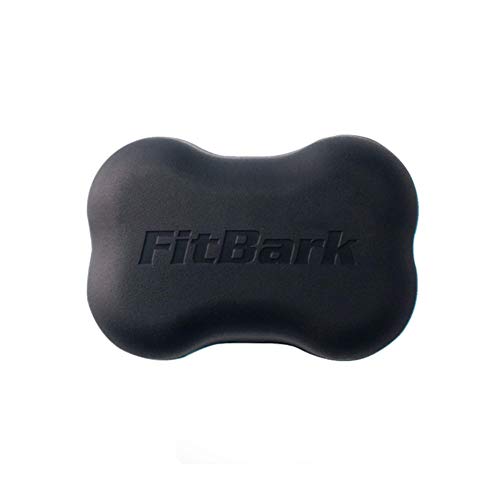
At 16 grams, the FitBark is the lightest tracker on this list by a wide margin, and that's the entire point. A bulky collar-mounted unit is a bigger deal on a 10-pound dog than a 70-pound one, and FitBark's clip-on design is built specifically to not weigh down a small breed. It's also waterproof and runs on 4G LTE across Verizon, AT&T, and T-Mobile networks, so carrier coverage isn't a single point of failure the way it can be with a tracker locked to one network.
Like the other cellular options here, it needs an active subscription to keep tracking. But for owners of small or toy breeds who've ruled out bulkier collar-style trackers on size alone, this is the one built for that specific problem.
Pros:
- 16-gram weight, noticeably lighter than collar-built trackers
- Waterproof construction holds up to rain and puddles
- Multi-carrier 4G LTE (Verizon, AT&T, T-Mobile) reduces dead-zone risk from any single network
- Clip-on design works with an existing collar instead of replacing it
Cons:
- Subscription required to keep the tracking feature active
- Small size means a smaller battery, which typically means more frequent charging
- Multi-carrier support doesn't help in areas with no coverage from any carrier
- Less suited to large or very active dogs than sturdier collar-integrated designs
FitBark GPS Dog Tracker 2nd Gen (2022) | Health & Location Pet Tracking Smart Collar Device | 4G LTE Multi-Carrier Verizon, AT&T & T-Mobile US Coverage | Small (16 g) & Waterproof | iPhone & Android
Check price on Amazon →
View FitBark GPS Dog Tracker 2nd Gen on Amazon
(#ad)5. Aorkuler GPS Dog Tracker - Best No-Subscription Pick
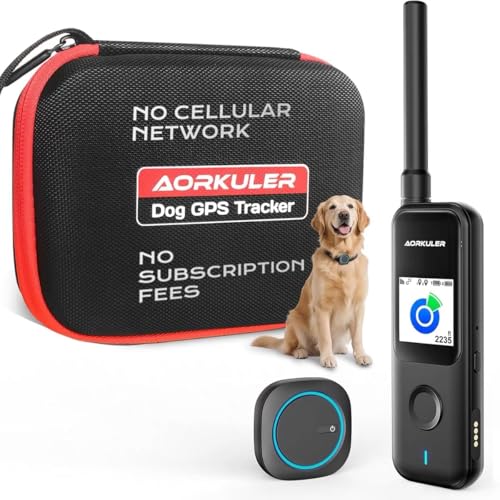
Every other tracker on this list needs a phone plan's worth of coverage to function. The Aorkuler doesn't, which is the reason to buy it. It tracks over radio between the collar tag and a handheld receiver up to 3.5 miles away, with no app and no monthly fee, ever. That makes it the obvious pick for hiking, hunting land, or any rural property where cell signal is unreliable or absent outright.
The trade-off is the range ceiling. 3.5 miles covers a hike, a hunting trip, or a large piece of land, but it won't help if a dog somehow ends up further than that, and there's no app-based history to check later the way cellular trackers offer. For anyone whose dog mostly roams within that distance and who doesn't want an ongoing bill, it's the simplest option here by a clear margin.
Pros:
- No app, no monthly fee, ever, unlike every other tracker on this list
- Works without phone or cell signal, ideal for rural and remote areas
- Tracks up to 3.5 miles between the collar tag and handheld receiver
- Straightforward setup with no account or subscription to manage
Cons:
- 3.5-mile range is a hard ceiling, unlike cellular trackers' effectively unlimited range within coverage
- No app means no location history or remote checking from a phone
- Not suited to a dog that could end up in dense urban terrain beyond the radio range
- Lacks the health-monitoring extras that Tractive and Fi offer
Aorkuler GPS Dog Tracker – Track Your Dog Up to 3.5 Miles Without Phone or Cell Signal | No App, No Monthly Fees | Ideal for Hiking, Rural & Remote Areas (Tracker 2)
Check price on Amazon →
View Aorkuler GPS Dog Tracker on Amazon
(#ad)Detailed Comparison Table
| Feature | Tractive (Best Overall) | Fi Series 3+ (Best Activity & Health) | Garmin Alpha LTE (Best for Hunting) | FitBark 2nd Gen (Best Small Dogs) | Aorkuler (Best No-Subscription) |
|---|---|---|---|---|---|
| Network Type | Cellular + app | Cellular + app | LTE cellular | 4G LTE, multi-carrier | Radio, no cell/app |
| Subscription | Included period, then recurring | 12-month included, then recurring | Required | Required | None, ever |
| Notable Feature | Heart rate & respiratory monitoring | Escape Alerts, Apple Watch compatible | Built for hunting/working dogs | 16g weight, waterproof | Works with zero cell signal |
| Attachment Style | Collar attachment | Full collar | Collar attachment | Clip-on to existing collar | Collar tag + handheld receiver |
| Best For | Most owners wanting health data + tracking | Escape-prone dogs, activity monitoring | Hunting/working dogs on large land | Small or toy breeds | Hikers, rural land, no-signal areas |
Quick Reference Guide
| Your Priority | Recommended Pick | Why |
|---|---|---|
| Best overall experience | Tractive GPS Dog Tracker | Live tracking, virtual fence, and vital-sign monitoring in one collar |
| Escape-prone dog | Fi Series 3+ GPS Dog Collar | Escape Alerts fire the moment your dog leaves home |
| Hunting or working dog on large land | Garmin Alpha LTE | Built specifically for that range and reliability demand |
| Small or toy breed | FitBark GPS Dog Tracker 2nd Gen | 16g clip-on design won't weigh down a small dog |
| No monthly fee, ever | Aorkuler GPS Dog Tracker | Radio-based, works with zero cell or app dependency |
| Hiking or hunting land with no cell signal | Aorkuler GPS Dog Tracker | Only tracker here that doesn't rely on cell coverage at all |
| Health monitoring beyond location | Tractive GPS Dog Tracker | Heart rate and respiratory tracking, not offered by most rivals |
| Multiple carriers in your area | FitBark GPS Dog Tracker 2nd Gen | Works across Verizon, AT&T, and T-Mobile instead of one network |
Getting the Most Out of a Dog GPS Tracker
-
Check real coverage before buying a cellular tracker — carrier coverage maps are a starting point, but the only real test is whether your phone gets a usable signal at the specific property or trail your dog runs on.
-
Set the virtual fence realistically — a boundary set too tight around a yard will trigger constant false alerts if your dog has any normal roaming space; give it enough margin to avoid alert fatigue that makes you start ignoring notifications.
-
Charge on a routine, not when the battery dies — a tracker that's dead in a drawer does nothing. Pair charging with something you already do daily, like feeding time, so it's never the reason a dog goes untracked.
-
Test the range before you need it — for radio-based trackers especially, walk the actual distance you expect your dog to cover and confirm the signal holds before relying on it in an emergency.
-
Keep the app's location history on, if it has one — a live pin is useful, but a history trail is what tells you which direction a dog went if you're following on foot rather than watching a screen in real time.
-
Attach it correctly — a loose-fitting tracker can spin around to the underside of the collar or fall off entirely; check the fit the same way you'd check a collar itself, with two fingers able to slide underneath.
Common Mistakes When Buying a Dog GPS Tracker
- Assuming all trackers work the same way — a cellular tracker and a radio-based tracker solve different problems. Buying a cellular unit for a property with no coverage, or a short-range radio unit for a dog that roams a whole neighborhood, means picking the wrong tool for the situation.
- Ignoring the subscription commitment — an included membership period runs out. Check what the ongoing plan actually requires before assuming the upfront cost is the only cost.
- Buying a collar-style tracker for a small dog without checking weight — a unit built for a 60-pound dog can be genuinely uncomfortable on a 10-pound one. Clip-on, lightweight designs exist for a reason.
- Skipping the range check for radio trackers — a 3.5-mile rated range assumes reasonably open terrain. Dense woods or hilly ground can shorten real-world range, so don't assume the spec sheet number holds everywhere.
- Forgetting the tracker needs charging like a phone — treating it as a fit-and-forget device is how it ends up dead exactly when a dog gets loose.
FAQ
Q: Do all dog GPS trackers require a monthly subscription?
A: No. Cellular trackers like Tractive, Fi, Garmin Alpha LTE, and FitBark all need an active plan to function, though most include a free period at purchase. Radio-based trackers like the Aorkuler never require a subscription because they don't use a cell network at all.
Q: How much range does a no-subscription tracker like the Aorkuler actually cover?
A: The Aorkuler is rated up to 3.5 miles between the collar tag and the handheld receiver. That's enough for most hikes, hunts, or rural properties, but it's a hard ceiling. A dog that ends up farther than that won't show up until it's back in range.
Q: Will a cellular tracker work in a national forest or other area with no cell service?
A: Not reliably. Cellular trackers depend entirely on carrier coverage in the specific location, and remote or heavily wooded areas often have gaps. If you regularly hike or hunt somewhere with unreliable signal, a radio-based tracker like the Aorkuler is the more dependable option.
Q: How long does the battery last between charges?
A: This varies by device and usage, and depends heavily on how often the tracker pings for location and whether extra features like health monitoring are running. Treat any tracker like a phone: check it on a routine, and don't assume it'll last indefinitely without attention.
Q: Do these trackers attach to any collar, or do I need a specific one?
A: It depends on the model. FitBark and the Aorkuler's collar tag are built to clip onto a collar you already own. Fi and Garmin's Alpha LTE are built as their own collar unit rather than an attachment.
Q: Can a GPS tracker replace a physical or invisible fence?
A: No. A tracker tells you where a dog is and, with virtual fence features like Tractive's or Fi's Escape Alerts, notifies you when it crosses a boundary. It doesn't physically stop a dog from leaving. It's a way to find a dog faster, not a containment system.
Q: Are these trackers safe for a dog that swims a lot?
A: Fi and FitBark are both built waterproof, which covers regular swimming and wet weather. Always check the specific model's water rating before assuming any tracker can handle repeated submersion.
Q: What's the real difference between a dog GPS tracker and something like an AirTag?
A: An AirTag-style tag relies on nearby phones to relay its location and has no independent GPS or cellular connection of its own, so it works best in populated areas with lots of other devices around. A true GPS tracker like the ones here has its own location hardware and, for cellular models, its own connection to report location from anywhere with coverage, populated or not.
Q: Can I track more than one dog on the same account?
A: Most of these brands support multiple devices under one account or app login, which matters if you have more than one dog. Check the specific app's multi-pet support before buying a second unit and assuming it'll just work.
Q: Do dog GPS trackers work for cats too?
A: Some do, though weight and size matter more for cats than dogs. A lightweight clip-on tracker like the FitBark is a more realistic fit for a cat collar than a bulkier unit built around a dog-sized collar.
Final Verdict
The Tractive GPS Dog Tracker is the pick for most owners. Live tracking and virtual fence alerts cover the core need, and the added heart rate and respiratory monitoring is a real feature most competitors skip entirely, not a gimmick tacked on for the spec sheet.
If your dog has a habit of testing the yard's limits, the Fi Series 3+ GPS Dog Collar is worth the switch specifically for Escape Alerts, which notify you the second your dog leaves rather than whenever you happen to check the app. Hunters and owners of working dogs covering large, remote properties should look at the Garmin Alpha LTE instead, since it's built around exactly that use case rather than backyard tracking. Small and toy breed owners get the better fit from the FitBark GPS Dog Tracker 2nd Gen, since 16 grams doesn't weigh down a dog the way a full collar-style tracker can.
And if a recurring bill is the dealbreaker, or your dog's usual territory doesn't have reliable cell coverage, the Aorkuler GPS Dog Tracker is the one to buy. No subscription, no app dependency, and it works exactly where cellular trackers can't.
Related: Building out the rest of your dog's gear? Check out our guides on no-pull harnesses for small dogs, pet carriers for travel, and orthopedic beds for large breeds.
Recommended
5 Best No-Pull Harnesses for Small Dogs in 2026: Stop Pulling Without Choking
5 best no-pull harnesses for small dogs in 2026 — stop pulling without choking. Top picks for Chihuahuas, Dachshunds & other small breeds.

Best Pet Carriers 2025: Airline-Approved & Car-Safe Options for Every Trip
Best pet carriers 2025: SturdiBag's crash-tested car seats vs Petseek's extra-large cat carrier, compared for airline approval, size, and comfort.

The 4 Best Orthopedic Bolster Beds for Large Breeds in 2026 (That Actually Protect Joints)
Best orthopedic dog beds 2026: joint support for large breeds over 50 lbs, including a sofa-style pick. Tested for quality, safety & comfort.
