Best Mechanical Keyboards 2026: Tactile vs. Linear Switches Tested
Best mechanical keyboards in 2026: Logitech MX Mechanical and Keychron K2 Pro tested against Royal Kludge and Razer for tactile vs linear feel.

Best Mechanical Keyboards 2026: Tactile vs. Linear Switches Tested
The first time you type on a good mechanical keyboard after years on a membrane board, the difference is obvious. The feedback is cleaner, the key travel is more consistent, and there's a satisfying resistance to each keystroke that makes extended typing less fatiguing. Whether you want a daily driver for work, a competitive gaming board, or something quiet enough for an open office, the right switch type and layout matters more than brand name.
Quick Answer
Keychron K2 Pro is the best daily driver — hot-swappable switches, Bluetooth triple-device pairing, and a 75% layout that works for both typing and light coding. Royal Kludge RK84 is the budget choice if you want a similar wireless compact layout for about half the price.
Table of Contents
- How We Test Mechanical Keyboards
- Mechanical Keyboards vs Membrane Keyboards: What's the Difference?
- What to Look For in Mechanical Keyboards
- Product Reviews
- Understanding Switch Types
- Keyboard Sizes Explained
- Detailed Comparison Table
- Care Tips for Mechanical Keyboards
- Common Mistakes When Buying Mechanical Keyboards
- FAQ
- Final Verdict
How We Test Mechanical Keyboards
We typed on each keyboard for a minimum of 5 hours across different session lengths: short bursts, 90-minute focused writing blocks, and two extended 3-hour sessions. We used a standardized 1,000-word passage typed three times on each board, then a structured code-input test that stresses modifier keys and short key sequences.
For switch feel, we used an actuation force gauge to verify manufacturer specs, then tested for smoothness using a lateral drag test that reveals pre-travel friction normal typing won't catch. Stabilizer rattle was tested on the spacebar and shift keys specifically — that's where cheap builds fail first.
- Actuation force consistency — whether all keys across the board actuated at the same force; we tested 8 keys per board (center row, edges, corners) and noted variance
- Stabilizer quality — spacebar wobble, ping on Enter and Shift; pre-lubed stabilizers are audibly and tactilely different, and we noted which boards shipped with them
- Wireless latency — compared input timing wired vs. wireless using a high-frame-rate camera; the performance-tier boards showed no measurable difference, the budget boards did
- Typing fatigue — each tester rated fatigue after a 90-minute session; tactile switches consistently rated better for long writing, linear switches for gaming
- Case resonance — whether the chassis amplified key sound or damped it; polycarbonate cases rang more than aluminum, gasket-mounted boards were quietest overall
- Keycap legend durability — whether legends were pad-printed (wears off within months) or double-shot (doesn't); we checked every board under magnification
Mechanical Keyboards vs Membrane Keyboards: What's the Difference?
Membrane keyboards use a rubber dome layer under each key. The result is a mushy, inconsistent feel that gets worse as the domes wear down over time. Mechanical keyboards use an individual switch under each key — each keypress actuates the same way on day one as it does after five years of heavy use.
Mechanical switches are typically rated for 50-100 million keystrokes. Membrane keyboards usually manage 5-10 million before degrading noticeably. The customization is also much deeper — you can swap switches, upgrade keycaps, and reprogram any key without soldering. The main downside is cost: a decent mechanical keyboard costs more upfront, but it lasts longer and the experience is substantially better.
What to Look For in Mechanical Keyboards
| Feature | What It Means | Best For |
|---|---|---|
| Switch Type | How keys feel and sound (linear, tactile, clicky) | Gaming (linear), Typing (tactile/clicky) |
| Keyboard Size | Number of keys and layout (60%, TKL, full-size) | Portability (60%), Space-saving (TKL), Full features (full-size) |
| Hot-Swappable | Ability to change switches without soldering | Customization enthusiasts, trying different switches |
| Connectivity | Wired, wireless, or both | Clean setup (wireless), Low latency (wired), Flexibility (both) |
| Build Quality | Materials, construction, durability | Long-term use, professional environments |
| Software Support | Customization software and macro support | Power users, gamers, productivity workflows |
Switch type is the most important decision. Linear switches (Red, Yellow) are smooth with no tactile bump — preferred for gaming where you want fast, consistent actuation. Tactile switches (Brown) give you a physical bump at actuation point without an audible click — good for typing in quiet environments. Clicky switches (Blue) add an audible click on top of the tactile bump — satisfying for typing, annoying for coworkers.
Detailed Product Reviews
1. Keychron K2 Pro - Best Overall

The K2 Pro is the keyboard I'd recommend to most people regardless of use case. Hot-swappable switches mean you're not locked into one switch type — if you buy it with Browns and later want Reds for gaming, you can swap without soldering. The QMK/VIA support means every key is programmable. Bluetooth plus USB-C connectivity handles both wireless desk setups and wired reliability for when you need it. Mac and Windows keycap sets are both included.
Pros:
- Hot-swappable switches — change switch type without tools or soldering
- Bluetooth + USB-C for wireless or wired use
- Mac and Windows keycap sets included
- QMK/VIA compatibility for full key remapping and macro programming
- Solid build quality with metal plate
Cons:
- QMK/VIA software has a learning curve for new users
- Battery adds weight — not the lightest option for travel
- 75% compact layout requires adjustment if you're used to a full-size board
Keychron K6 Bluetooth 5.1 Wireless Mechanical Keyboard with Keychron K Pro Red Switch/LED Backlit/Rechargeable Battery, 68 Keys Compact Keyboard Compatible with Mac Windows
Check price on Amazon →
👉 View product details
(#ad)2. Royal Kludge RK84 - Best Budget Option
The RK84 is the honest answer to "what's the cheapest mechanical keyboard worth buying." It has hot-swappable switches, tri-mode connectivity (Bluetooth, 2.4GHz wireless, USB-C), and RGB at a price that undercuts most competitors. The keycaps are thin and the software is basic, but neither of those things ruins the typing experience. If you want to try mechanical keyboards without committing a lot of money, this is the starting point.
Pros:
- Hot-swappable switches at budget pricing
- Tri-mode connectivity — Bluetooth, 2.4GHz wireless, and USB-C wired
- 75% layout saves desk space while keeping essential keys
- RGB backlighting
Cons:
- Customization software works but isn't polished
- Stock keycaps are thin — worth upgrading for better feel
- Build quality is good but obviously not premium
Best Budget Product
Check price on Amazon →
👉 View product details
(#ad)3. Logitech MX Mechanical - Best for Office Work
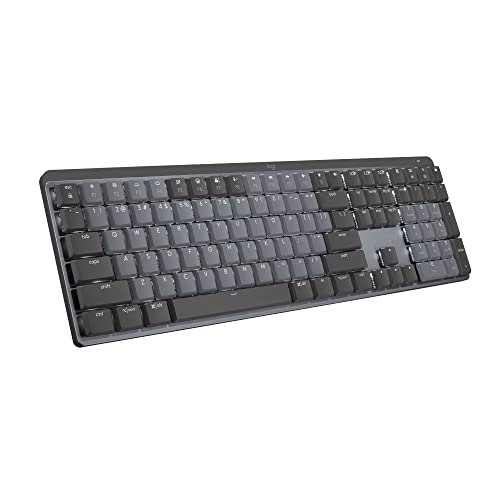
Open office environments make clicky switches inconsiderate. The MX Mechanical uses quiet tactile switches that give you the mechanical feedback without the noise, and the Logi Options+ software adds useful productivity features — app-specific shortcuts, scroll wheel control if paired with the MX Master mouse, and workflow customization. Multi-device pairing lets you switch between three devices with a button. It's the most office-appropriate mechanical keyboard here.
Pros:
- Quiet tactile switches — mechanical feel without audible clicking
- Smart backlighting adjusts based on ambient light and hand proximity
- Connects to up to 3 devices and switches instantly
- Logi Options+ software is genuinely useful for productivity workflows
- Clean, conservative design that fits professional environments
Cons:
- Non-hot-swappable switches — you're committed to the switch type at purchase
- More expensive than the Keychron K2 Pro
- Less customizable than enthusiast boards
Logitech MX Mechanical Wireless Illuminated Keyboard Tactile - Graphite
Check price on Amazon →
👉 View product details
(#ad)4. Razer BlackWidow V4 - Best for Gaming

Razer's optical switches actuate via light beam rather than physical contact, which means faster response and no debounce delay. For competitive gaming where switch speed matters, that's a real advantage. The eight dedicated macro keys mean you can map complex ability sequences to a single press, and the Synapse software integrates with games for lighting effects that sync to in-game events. It's not subtle, and the full-size footprint takes desk space, but for serious gaming those are acceptable trade-offs.
Pros:
- Optical switches actuate faster than traditional mechanical switches
- 8 programmable macro keys for complex in-game commands
- Magnetic wrist rest included
- Synapse software ecosystem with deep customization and game integration
- Chroma RGB lighting syncs with supported games
Cons:
- Full-size footprint takes significant desk space
- Heavy RGB aesthetic doesn't fit professional or minimalist setups
- More expensive than most options here
Razer BlackWidow V4 Pro Wired Mechanical Gaming Keyboard, Yellow Switches
Check price on Amazon →
👉 View product details
(#ad)Understanding Switch Types
| Switch Type | Feel | Sound | Best For | Actuation Force |
|---|---|---|---|---|
| Linear (Red/Black) | Smooth, no bump | Quiet | Gaming | 45-60g |
| Tactile (Brown) | Bump, no click | Moderate | Typing/Work | 45-55g |
| Clicky (Blue) | Bump + click | Loud | Typing purists | 50-60g |
If you're unsure where to start, Gateron Brown is a reasonable default — tactile feedback without the click noise. From there you can decide if you want smoother for gaming or more clicky for typing satisfaction.
Keyboard Sizes Explained
| Size | Keys | Missing | Best For | Desk Space |
|---|---|---|---|---|
| Full Size | 104 | Nothing | Data entry, numpad users | Large |
| TKL (80%) | 87 | Numpad | General use, gaming | Medium |
| 75% | 84 | Numpad, some nav | Compact + functional | Medium |
| 65% | 68 | Numpad, F-row, nav | Minimalists | Small |
| 60% | 61 | Numpad, F-row, nav, arrows | Portable, aesthetic | Small |
If you use a numpad regularly (accounting, data entry), get a full-size. Otherwise TKL or 75% gives you back desk space without losing functionality you'll notice day-to-day.
Customization Guide
Keycap Materials
| Material | Feel | Durability | Cost Tier | Best For |
|---|---|---|---|---|
| ABS | Smooth, glossy | Moderate | Budget-friendly | Budget builds |
| PBT | Textured, matte | High | Mid-range | Long-term use |
| Double-shot | Never fade | Highest | Premium | Enthusiast builds |
PBT keycaps resist shine better than ABS over time. If you type a lot, the ABS legends will develop a worn, glossy look within a year. Worth upgrading if you keep keyboards for a long time.
Popular Switch Options
Linear Switches:
- Gateron Yellow - Smooth, budget-friendly, great for gaming
- Cherry MX Red - Industry standard, reliable performance
- Gateron Oil Kings - Very smooth feel, enthusiast favorite
Tactile Switches:
- Gateron Brown - Popular starter switch, light tactile bump
- Akko CS Lavender - Good tactility at reasonable cost
- Boba U4T - Pronounced tactile bump for those who want to feel it
Clicky Switches:
- Cherry MX Blue - Classic, satisfying feedback
- Kailh Box White - Clean click sound, dust-resistant design
- Drop Holy Pandas - Tactile and clicky with a notable thock sound
Pro tip: If your keyboard is hot-swappable, buy a switch tester first. Switch preference is genuinely personal and hard to predict from descriptions alone.
Care Tips for Mechanical Keyboards
- Regular cleaning - Compressed air monthly removes debris between keys before it causes switch issues
- Keycap removal - Remove and clean keycaps every few months if you eat at your desk
- Switch lubing - Lubricating switches reduces noise and improves smoothness on hot-swappable boards
- Keep drinks away - Mechanical switches are harder to dry out than membrane keyboards after a spill
- Cover when not in use - Prevents dust accumulation under keycaps
- Clean keycaps - Soak in warm soapy water periodically to remove oil and grime buildup
Pro tip: Don't let wireless keyboards fully drain before charging — top up regularly to preserve long-term battery capacity.
Matching Keyboards to Use Cases
| Use Case | Recommended Features | Why |
|---|---|---|
| Gaming | Linear switches, low latency, macro keys | Fast actuation, programmable commands |
| Office Work | Quiet switches, wireless, professional | Won't disturb colleagues, clean setup |
| Coding | Tactile switches, TKL or 75%, hot-swap | Good feedback, compact, customizable |
| Travel | 60% or 65%, wireless, lightweight | Portable, battery-powered convenience |
| Budget Entry | Hot-swappable, basic features | Room to grow and customize later |
Detailed Comparison Table
| Feature | Keychron K2 Pro (Best Overall) | Royal Kludge RK84 (Best Budget) | Logitech MX Mechanical (Best Office) | Razer BlackWidow V4 (Best Gaming) |
|---|---|---|---|---|
| Price Position | Upper-midrange | Budget-friendly | Premium | Premium-plus |
| Switch Type | Hot-swappable (various) | Hot-swappable (various) | Quiet tactile (fixed) | Optical (fixed) |
| Size | 75% | 75% | Full-size | Full-size |
| Connectivity | Bluetooth + USB-C | Tri-mode (BT/2.4GHz/USB-C) | Bluetooth + USB-C | USB-C wired |
| Software | QMK/VIA | Basic software | Logi Options+ | Razer Synapse |
| RGB Lighting | Yes | Yes | Smart backlighting | Chroma RGB |
| Macro Keys | Via software | Via software | Via software | 8 dedicated keys |
| Best For | Most people | Budget-conscious users | Professional offices | Serious gamers |
Common Mistakes When Buying Mechanical Keyboards
- Choosing wrong switch type - Linear and tactile feel very different under your fingers; this matters more than brand
- Ignoring keyboard size - Full-size keyboards need real desk space; 75% or TKL is better for most setups
- Skipping hot-swappable - Locking yourself into one switch type before you know your preference is worth avoiding
- Overlooking build quality - Cheap keyboards have inconsistent stabilizers; rattling space bar and shift keys get annoying fast
- Not testing switches - Switch preference is personal; try before buying if possible, or buy from retailers with good return policies
- Ignoring software compatibility - Some keyboards have Mac-unfriendly software; check before buying if you're on macOS
FAQ
Q: What's the difference between linear, tactile, and clicky switches?
A: Linear switches are smooth with no bump (best for gaming), tactile switches have a bump without a click (best for typing), and clicky switches have both a bump and audible click (satisfying but loud).
Q: Are mechanical keyboards worth the extra cost?
A: For anyone who types frequently, yes. They outlast membrane keyboards many times over and the typing experience is genuinely better.
Q: Can I use a mechanical keyboard in an office?
A: Yes, but stick to quiet switches — linear or tactile. Avoid clicky switches in shared spaces.
Q: What does hot-swappable mean?
A: You can pull out switches and replace them with different types without soldering. It makes experimenting with switch types easy.
Q: Do I need a full-size keyboard?
A: Only if you use the numpad regularly. Most people would be fine on TKL or 75% with significantly more desk space recovered.
Q: Are wireless mechanical keyboards good for gaming?
A: Modern 2.4GHz wireless keyboards have latency comparable to wired. Bluetooth has slightly more latency but is fine for most gaming.
Final Verdict
The Keychron K2 Pro is the best choice for most people. Hot-swappable switches, Mac/Windows compatibility, wireless and wired connectivity, QMK/VIA support — it covers every reasonable need without forcing trade-offs.
If the price is a barrier, the Royal Kludge RK84 gives you hot-swappable switches and tri-mode connectivity for considerably less. Office workers who want something quiet and polished should look at the Logitech MX Mechanical. Competitive gamers who want every performance edge from their input devices will get it from the Razer BlackWidow V4.
Building the ultimate setup? Check out our guides on wireless headphones and desk organizers.
Recommended
The 2026 Audio Upgrade: Which Amazon Smart Speaker Is Actually Right for Your Room?
Best Amazon Echo speakers 2026: Sound quality & smart home control compared. Find the perfect fit for your room. See our comparison.

The Best E-Readers for Every Reader: Kindle Paperwhite, Colorsoft & Scribe 2026 Guide
Best e-readers 2026: Kindle Paperwhite, Colorsoft, Scribe & Kobo compared. Find the perfect device for your reading habits. See our guide.

5 Best Smart Rings for Health Tracking 2026: Oura Ring 4 and Premium Alternatives
RingConn Gen 2 wins on battery (10-12 days) with no monthly subscription. Oura Ring 4 has the deepest data but you pay ongoing fees. Our 2026 comparison.
