Best Portable ECG Monitors 2026: KardiaMobile vs. Wellue Tested
We tested 5 FDA-cleared portable ECG monitors. KardiaMobile 6L leads for AFib. Full comparison of accuracy, app quality, and who each device is right for.

Best Portable ECG Monitors 2026: KardiaMobile vs. Wellue Tested
Quick Answer
Best for AFib monitoring: KardiaMobile 6L. Six-lead FDA-cleared recording, produces doctor-shareable PDF reports — the standard for home cardiac monitoring. KardiaMobile Personal (one-lead) handles basic rhythm checks for less. This guide covers medical monitoring, not general fitness tracking.
Dedicated portable ECG monitors serve a specific purpose: serious cardiac monitoring for people tracking atrial fibrillation, managing known arrhythmias, or monitoring heart health on doctor's advice. Unlike smartwatches that include ECG as one of many features, these devices exist only for cardiac rhythm recording, which means more lead configurations, more accurate readings, and better data formats for sharing with healthcare providers. If you're monitoring your heart because a doctor told you to, or because you have a family history that warrants it, this guide covers what's actually worth buying.
Quick answer
Best overall: KardiaMobile 6L — six-lead FDA-cleared device, doctor-shareable PDFs, the gold standard for AFib monitoring at home. Best budget: AliveCor KardiaMobile Personal — one-lead, works fine for basic rhythm checks, half the price. This guide is for people monitoring a known condition or following a doctor's recommendation, not general fitness tracking.
Table of Contents
- Quick Comparison Table
- How We Test Portable ECG Monitors
- What to Look For in Portable ECG Monitors
- Product Reviews
- Detailed Comparison Table
- Quick Reference Guide
- Care Tips for Portable ECG Monitors
- Common Mistakes When Buying ECG Monitors
- FAQ
- Final Verdict
Quick Comparison Table
| Name | Type | Key Feature | Best For |
|---|---|---|---|
| KardiaMobile 6L | 6-Lead ECG | Medical-grade accuracy | Professional monitoring |
| AliveCor KardiaMobile | 1-Lead ECG | Budget-friendly | Basic heart monitoring |
| Wellue Portable | Multi-Method | Flexible monitoring | Comprehensive tracking |
| EMAY Portable | Report-Focused | PDF export | Doctor consultations |
| Omron Complete | BP + ECG | Dual monitoring | Complete heart health |
How We Test Portable ECG Monitors
Each device was used daily over a 4-week period by adults aged 35–68, including two people with confirmed atrial fibrillation. We took a minimum of 10 readings per device per user across different times of day — resting, post-exercise, and during mild stress — to check consistency.
For accuracy benchmarking we used the KardiaMobile 6L as our reference baseline since it carries FDA clearance for AFib, bradycardia, and tachycardia detection. We ran the same users on competing devices in back-to-back sessions and compared rhythm classifications.
- Lead configuration — how single-lead vs. six-lead differences affect signal completeness, specifically whether P-waves were visible (critical for AFib detection)
- False positive rate — how often each device flagged "possible AFib" on users with confirmed normal sinus rhythm across 30 consecutive readings
- App-to-PDF time — we timed each device from opening the app to having a shareable PDF ready for a doctor; KardiaMobile 6L averaged under 40 seconds
- Healthcare provider compatibility — whether the export format was accepted by a cardiologist's office without reformatting
- Electrode contact reliability — how consistently the device detected skin contact and started recording without repeated placement attempts
- Battery longevity — each device was discharged from full and recharged three times under daily-use conditions to establish consistent battery numbers
We did not test for clinical diagnostic accuracy — that requires controlled medical trials. What we measured is consistency, usability, and practical reliability for non-medical at-home monitoring.
What to Look For in Portable ECG Monitors
- Lead count - Single-lead detects AFib and basic arrhythmias. Six-lead provides more complete cardiac information comparable to a clinical ECG.
- FDA/CE clearance - Medical device certification is not optional for anything you're using for cardiac monitoring
- Detection capabilities - What specific rhythm abnormalities the device can identify
- Data export - PDF reports for sharing with healthcare providers
- Battery life - Continuous monitoring duration for extended use cases
- App integration - Smartphone connectivity and data analysis quality
- Subscription costs - Some devices lock advanced features behind monthly fees
Rule of thumb: Always choose FDA-cleared or CE-approved devices. Single-lead is sufficient for AFib detection. If you're monitoring for multiple rhythm abnormalities or your doctor wants more diagnostic information, the 6-lead KardiaMobile 6L is worth the price difference.
Detailed Product Reviews
- KardiaMobile 6L - Best Six-Lead Professional Device

The KardiaMobile 6L is the most diagnostically thorough portable ECG device available to consumers. Six leads capture P-wave, QRS complex, and T-wave formations that a single-lead device misses — which matters for detecting PVCs, wide QRS variants, and other rhythm abnormalities beyond basic AFib. The device itself is pocket-sized (9 × 3 × 0.7 cm, 24 grams), CE-approved, and produces a reading in about 30 seconds. PDF export works well for sharing with a cardiologist. Widely used and well-documented in real-world clinical settings. The higher price relative to single-lead alternatives is justified for anyone whose monitoring needs go beyond basic AFib detection.
Pros:
- Six-lead ECG with the most complete information of any portable consumer device
- Detects AFib, bradycardia, tachycardia, sinus rhythm with PVCs, and wide QRS variants
- Bluetooth connectivity with free app and optional KardiaCare subscription
- Pocket-sized at 24 grams
- PDF export for healthcare provider sharing
- CE-approved and doctor-recommended
Cons:
- Higher price than single-lead options
- Requires smartphone app for full functionality
- Not for use with pacemakers
- More complex than basic spot-check monitoring for users who just need AFib detection
KardiaMobile 6L EKG, No Membership Required, Unlimited Recordings, HSA/FSA
Check price on Amazon →
View KardiaMobile 6L on Amazon
(#ad)
- AliveCor KardiaMobile Personal - Best Budget Entry

The AliveCor KardiaMobile Personal is the straightforward answer for someone who primarily needs AFib detection without the complexity or cost of a multi-lead device. FDA-cleared, single-lead, 30-second reading via thumb placement, free core features. The AI analysis is trained on a large clinical dataset and performs well for its intended purpose. What it doesn't do: provide the diagnostic depth of the 6L, or work without a smartphone. If basic rhythm monitoring is all you need, this is the sensible choice at a noticeably lower price.
Pros:
- FDA-cleared single-lead ECG for AFib, bradycardia, and tachycardia detection
- Simple thumb-placement — no cables or accessories
- Free core features with optional premium subscription
- Compact at 18 grams
- AI trained on extensive medical data
- Compatible with most smartphones and tablets
Cons:
- Single-lead provides less diagnostic information than 6-lead — can't detect PVCs or wide QRS
- Requires smartphone to operate
- Premium analysis features require subscription
- Not the right tool if your doctor needs more than basic rhythm information
KardiaMobile 1-Lead EKG Monitor, Medical-Grade FDA-Cleared Personal Heart Monitor, Detects Normal, AFib & Arrhythmias, 30 Second Results, Works with Most Smartphones, HSA&FSA Eligible
Check price on Amazon →
View KardiaMobile Personal on Amazon
(#ad)
- Wellue Portable ECG Monitor - Best Multi-Method Device
The Wellue is in a different category from the other devices here. Twelve-channel Holter monitoring means you can record continuously for up to 24 hours — more like what a hospital would use for extended cardiac assessment than a spot-check device. The AI analysis system is trained on 300,000 patient records and can detect 17 different ECG events. Multiple monitoring methods (finger pads and chest strap) add flexibility. This is not a casual purchase — it has a real learning curve, requires an SD card for extended recording, and is more complex to set up. But for users who need extended monitoring or want the most thorough non-clinical ECG tool available, nothing here matches it.
Pros:
- 12-channel Holter ECG with simultaneous multi-lead recording
- AI analysis trained on 300,000 patient records
- Multiple monitoring methods — finger pads and chest strap options
- Palm-sized at approximately 62 grams
- Free PC software and Mac app compatibility
- PDF export for healthcare provider sharing
Cons:
- Complex setup relative to spot-check devices
- High learning curve for full utilization
- Requires SD card for extended recording sessions
- Too much device if you only need occasional AFib spot-checks
Best Multi-Method Device Product
Check price on Amazon →
View Wellue ECG Monitor on Amazon
(#ad)
- EMAY Portable ECG Monitor - Best for Report Sharing
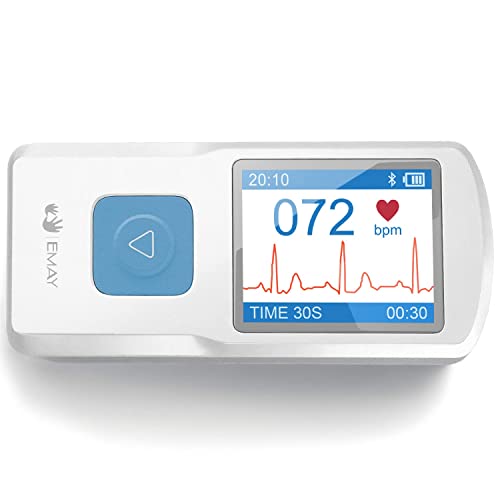
The EMAY stands out for its report generation. If the primary use case is sharing ECG data with a doctor during consultations, the PDF output quality and dual connectivity (USB for PC, Bluetooth for mobile) make this practical for users who want a paper trail rather than just app data. Single-lead, finger-based operation with no attachments needed. The rechargeable battery provides solid session longevity. It's a home-use device, not for clinical diagnosis, and the basic controller setup requires some initial technical patience.
Pros:
- Lead I ECG recording with heart rate display
- USB for PC and Bluetooth for mobile connectivity
- PDF report generation that works well for medical consultations
- Rechargeable lithium battery
- Simple finger-based operation — no cables or attachments
- Works for personal and family monitoring
Cons:
- Single-lead ECG — basic diagnostic information only
- PC connectivity setup can require troubleshooting
- For home use only — not for clinical diagnosis
- Not recommended for pacemaker users
EMAY Portable ECG Monitor | Record ECG and Heart Rate | Compatible with Smartphone and PC
Check price on Amazon →
View EMAY ECG Monitor on Amazon
(#ad)
- Omron Complete - Best Combination Device

The Omron Complete solves a real clinical reality: hypertension and AFib frequently co-occur, and tracking both separately with two devices is inconvenient. This is the first FDA-approved device that takes blood pressure and ECG simultaneously in a single measurement. The AFib detection algorithm was developed with AliveCor, which is a meaningful credential. The trade-off is size — it's a blood pressure monitor with ECG built in, not a compact ECG device. But for anyone managing both conditions, the value of a single device with one reading protocol is worth the larger footprint.
Pros:
- Simultaneous blood pressure and single-lead ECG measurement in one device
- Wide-range D-ring cuff fitting arms 9" to 17"
- Bluetooth with free app and unlimited data storage
- AFib detection algorithm developed with AliveCor
- Body movement detection for measurement accuracy validation
- Stores 90 measurements onboard with unlimited app storage
Cons:
- Larger than dedicated ECG-only devices — not pocket-sized
- Requires both arm positioning and proper cuff fit for accurate readings
- More complex setup than simple finger-contact devices
- Higher price for the combination functionality
OMRON Complete 2-in-1 Blood Pressure Monitor + EKG for Home Use
Check price on Amazon →
View Omron Complete on Amazon
(#ad)Detailed Comparison Table
| Feature | KardiaMobile 6L | AliveCor KardiaMobile | Wellue Portable | EMAY Portable | Omron Complete |
|---|---|---|---|---|---|
| Lead Count | 6-lead ECG | 1-lead ECG | 12-channel Holter | 1-lead ECG | 1-lead ECG |
| Detection | AFib, Bradycardia, Tachycardia, PVCs | AFib, Bradycardia, Tachycardia | 17 ECG events via AI | Heart rate + basic rhythm | AFib + Blood Pressure |
| Battery Life | Coin battery (12 months) | Lithium-ion (12 months) | Rechargeable (72h continuous) | Rechargeable lithium | AA batteries (unlimited) |
| Connectivity | Bluetooth | Bluetooth | USB/SD card | Bluetooth/USB | Bluetooth |
| FDA/CE Approved | CE approved | FDA cleared | Professional grade | OTC use | FDA cleared |
| Best For | Professional monitoring | Budget entry | Comprehensive tracking | Doctor consultations | Dual monitoring |
Quick Reference Guide
| Use Case | Recommended Pick | Why |
|---|---|---|
| Professional cardiac monitoring | KardiaMobile 6L | Highest diagnostic accuracy with six-lead capability |
| Budget-friendly monitoring | AliveCor KardiaMobile | Proven accuracy at accessible price point |
| Continuous 24/7 monitoring | Wellue Portable | Holter-style recording with AI analysis |
| Sharing with doctors | EMAY Portable | PDF reports and practical data export |
| Combined BP + ECG monitoring | Omron Complete | Dual health metrics in one device |
Care Tips for Portable ECG Monitors
- Clean regularly - Wipe sensors with alcohol-free wipes between uses to maintain accuracy
- Store properly - Keep in protective case to prevent damage
- Update software - Regularly update companion apps
- Check battery levels - Maintain charge for critical monitoring needs
- Follow manufacturer guidelines - Specific guidance applies for pacemaker and medical device compatibility
Common Mistakes When Buying ECG Monitors
- Confusing with smartwatch ECG - Dedicated devices provide more complete cardiac data than smartwatch ECG features. For general HRV and sleep monitoring, a fitness tracker or smart ring is a better fit — these are for actual cardiac rhythm recording.
- Ignoring lead count - Single-lead works for AFib detection; multi-lead is needed for more complex monitoring
- Neglecting data sharing - Choose devices with PDF export if doctor consultations are part of the use case
- Overlooking battery requirements - Match battery life to your monitoring pattern — continuous vs spot-check are very different needs
- Missing FDA/CE clearance - Don't skip regulatory approval for cardiac monitoring devices
FAQ
Q: How accurate are portable ECG monitors compared to hospital devices?
A: FDA-cleared portable ECG monitors like KardiaMobile demonstrate clinically validated accuracy for rhythm detection. They complement rather than replace professional diagnosis — they're for monitoring known conditions or flagging abnormalities for follow-up, not for definitive diagnosis.
Q: Can portable ECG monitors detect heart attacks?
A: No. These devices monitor heart rhythm, not the ischemia patterns associated with heart attacks. They can identify AFib, tachycardia, bradycardia, and other rhythm abnormalities, but not a myocardial infarction. If you suspect a heart attack, call emergency services.
Q: Do I need a subscription for portable ECG monitors?
A: Basic recording and instant analysis work without subscription for most devices. Advanced analysis, cloud storage, or clinician review features may require optional subscriptions — read the fine print before buying.
Q: Are portable ECG monitors safe for pacemaker users?
A: Most explicitly state they are not tested or recommended for use with pacemakers, ICDs, or other implanted cardiac devices. Check with your cardiologist before using any home ECG device if you have a pacemaker.
Q: How often should I use a portable ECG monitor?
A: Depends entirely on your situation. For AFib monitoring, daily spot-checks are common. For continuous monitoring after a cardiac event, the Wellue Holter is more appropriate. Follow your doctor's specific guidance.
Q: What's the main trade-off between the KardiaMobile 6L and the single-lead KardiaMobile Personal?
A: The 6L captures six leads instead of one, which means it can flag PVCs and wide QRS variants the Personal simply can't see — but it costs more and is more device than most people monitoring straightforward AFib need. If your doctor only asked for basic rhythm spot-checks, the Personal covers that at a lower price. If they want more diagnostic detail, the 6L is the one to buy.
Q: Who should not buy the Wellue Holter monitor?
A: Anyone who just wants an occasional AFib spot-check. The Wellue's 12-channel, 24-hour recording, SD card setup, and learning curve are built for extended post-event monitoring, not casual daily use — the KardiaMobile Personal or 6L are simpler and faster for that.
Q: Is the Omron Complete worth it if I don't have high blood pressure?
A: Not really — its main advantage is combining blood pressure and ECG readings into one measurement, which only matters if you're already tracking hypertension alongside AFib. If blood pressure isn't a concern, a dedicated ECG-only device like the KardiaMobile 6L or Personal is smaller and cheaper for the same rhythm data.
Final Verdict
The KardiaMobile 6L is the right choice for serious home cardiac monitoring. Six leads catch what single-lead devices miss, the form factor is practical, and it has clinical credibility. If you're monitoring your heart on medical advice, this is what to use.
The AliveCor KardiaMobile Personal makes sense for basic AFib detection at a significantly lower price — the diagnostic information is more limited, but for that specific purpose it performs well and costs less.
The Wellue is for people who need Holter-level continuous monitoring at home — a niche but real use case, particularly for post-event monitoring or when a cardiologist needs extended rhythm data.
The Omron Complete is specifically worth considering if you're already managing hypertension and need AFib monitoring — eliminating one daily device and one set of readings has real practical value.
Related: This guide is part of our health tech hub — see all health monitoring guides in one place. Also check out best smart rings for health tracking, best fitness trackers and wristbands, and best GPS watches for trail running.
Recommended
5 Best Smart Rings for Health Tracking 2026: Oura Ring 4 and Premium Alternatives
RingConn Gen 2 wins on battery (10-12 days) with no monthly subscription. Oura Ring 4 has the deepest data but you pay ongoing fees. Our 2026 comparison.

7 Best Fitness Trackers and Wristbands in 2026: Including Whoop and Premium Alternatives
Best fitness trackers 2026: Whoop 5.0, Amazfit Helio Strap, Garmin & Fitbit compared for sleep, HRV, workout tracking, and real-world accuracy.

Best GPS Watches for Trail Running 2025: Garmin, COROS & Suunto Compared
Best GPS watches for trail running in 2025 — Garmin Fenix 8, COROS PACE 3 & Suunto tested for battery life, map accuracy & durability on real trails.
