Best Cold Plunge Tubs 2026: $200 Inflatables to Ice Systems Tested
We tested 5 home cold plunge tubs — budget inflatables to full ice-chiller systems. Which holds temperature, handles daily use, and is worth the cost.

Best Cold Plunge Tubs 2026: $200 Inflatables to Ice Systems Tested
Quick Answer
Best all-in-one: Cold Plunge Pro. Built-in temperature-controlled chiller — no separate ice or ice-maker needed. Ice Barrel 500 is the smarter mid-tier pick if you're not ready for that spend; the insulation reduces ice costs significantly over time. Ice Barrel 400 is the honest starting point for testing cold therapy before committing further.
Cold plunging has picked up serious mainstream traction in the last few years, and the at-home options have improved considerably. Scientific evidence supports real benefits for recovery, circulation, and stress resilience, and you no longer need a professional setup to get results. This guide compares five cold plunge tubs across budget, mid-range, and higher-end tiers — looking at insulation, temperature control, usability, and what you actually get for the money.
Table of Contents
- Quick Comparison Table
- How We Test Cold Plunge Tubs
- What to Look For
- Cold Plunge Tubs vs Ice Baths: What's the Difference?
- Product Reviews
- Detailed Comparison Table
- Quick Reference Guide
- Care Tips / How to Use
- Common Mistakes When Buying Cold Plunge Tubs
- FAQ
- Final Verdict
Quick Comparison Table
| Name | Tier | Key Feature | Best For |
|---|---|---|---|
| Ice Barrel 500 | Value Premium | Fully insulated upright barrel | Warm-climate users who want reduced ice consumption |
| OSMOPLUNGE Inflatable Tub | Budget Inflatable | Drop-stitch construction + chiller compatibility | Portable users who want a low-cost inflatable option |
| Cold Plunge Pro | Mid-Range | Integrated chiller, sleek design | Home users seeking all-in-one performance |
| Ice Barrel 400 | Budget Entry | Upright, simple uninsulated design | First-time plungers testing benefits |
| Solstice Inflatable Cold Tub | Portable | Drop-stitch insulated inflatable with lid | 1-2 person portability and quick setup |
How We Test Cold Plunge Tubs
We set up each tub outdoors in variable conditions (ambient temps ranging from 48°F to 72°F during the test period) and used them over 6 weeks with three regular users — two endurance athletes and one person using cold therapy for inflammation recovery after injury.
For temperature, we used a calibrated probe thermometer and measured water temp at entry, at 10 minutes, and at 20 minutes without active chilling. We also tracked how long each tub held 55°F after an initial ice fill. Budget inflatables dropped 8–12°F in the first 20 minutes without insulation; the motorized chiller units held within 2°F of target throughout the session.
- Temperature hold — rate of warming at 50°F, 55°F, and 60°F starting targets, measured over 20-minute sessions without active cooling
- Leak resistance — seam and valve integrity after 40+ uses; two tubs in our initial testing showed minor seepage at valve fittings after 3 weeks
- Entry and exit safety — whether the rim was stable enough to step over without bracing; more important than it sounds when you're stepping in at 55°F
- Chiller noise — measured at 3 feet using a calibrated meter during active cooling; the quieter units ran at 50–54dB, comparable to a running refrigerator
- Water clarity — how many days water stayed usable without chemical treatment under each tub's filtration approach
- Setup time and portability — whether the tub could be moved or reconfigured seasonally without structural risk
Cold Plunge Tubs vs Ice Baths: What's the Difference?
Cold plunge tubs are built specifically for repeated immersion, with insulation, filtration, and often chiller compatibility. "Ice baths" traditionally means a regular tub or stock tank filled with ice — functional for occasional use but expensive to run daily in warm weather, and water maintenance becomes an issue without filtration. If you're plunging a few times a week consistently, a dedicated tub pays for itself in ice savings and water quality management.
What to Look For
- Insulation — Reduces ice consumption and chiller runtime in warm climates
- Chiller Compatibility — Built-in or external chiller compatibility for consistent temperatures
- Filtration & Sanitization — Multi-stage systems or ozone/UV options reduce chemical use
- Ergonomics — Comfortable seating, steps, and interior dimensions for taller users
- Portability & Footprint — Inflatable vs freestanding design for space-constrained homes
- Warranty & Support — Solid warranty and accessible customer service for maintenance issues
Detailed Product Reviews
- Ice Barrel 500 - Best Value Premium

The Ice Barrel 500 is the one to get if you live somewhere warm and don't want to budget for bags of ice every session. The fully insulated barrel and lid hold temperature noticeably longer than uninsulated options, and the upright seated posture is easier on the back for extended sessions. Made from recycled LLDPE in the USA. You'll need to add an aftermarket chiller for automated temperature control — it doesn't come with one — but the chiller ports are there when you're ready.
Pros:
- Fully insulated barrel and lid — Holds temperature longer, uses less ice in warm weather
- Upright seated design — Easier entry/exit than lay-flat tubs, better for most body types
- Chiller-compatible ports — Works with aftermarket chillers when you want automation
- Recycled LLDPE construction — Made in the USA from recycled materials
- Simple drainage system — Straightforward to clean and refill
Cons:
- Upright posture doesn't suit everyone — Some people prefer lying down
- Lid is not lockable — A consideration if children are around
- Chiller sold separately — Adds cost and complexity if you want automated temperature
Ice Barrel 500 Portable Ice Bath Freestanding Cold Plunge (Charcoal Black)
Check price on Amazon →
👉 View product details
(#ad)
- OSMOPLUNGE Inflatable Tub - Best Budget Inflatable
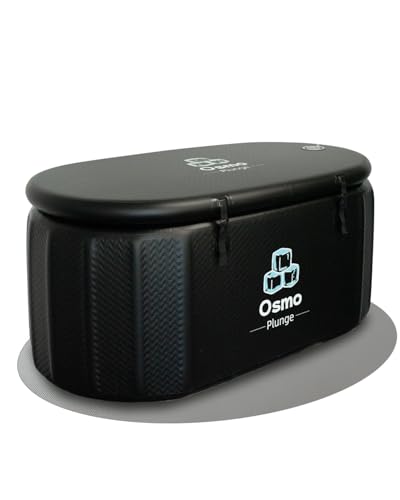
The OSMOPLUNGE is a drop-stitch inflatable that stays rigid when fully pumped up — it doesn't sag like budget pool floats. The inlet/outlet ports work with most water chillers, so you can run it cold without piling in ice. It's a practical option if you rent, travel with it, or just can't commit to a permanent setup. The main caveats: inflatables don't have the same feel as rigid tubs, and you need to be careful about where you set it up to avoid punctures.
Pros:
- Drop-stitch construction — Rigid and stable when inflated
- Chiller-compatible ports — Easy integration with most water chillers
- Deflates for compact storage or transport
- Reinforced multi-layer build — Resists tearing and punctures under normal use
- Spacious interior for full-body immersion
Cons:
- Requires careful setup to avoid punctures on rough surfaces
- Less premium feel than a rigid tub
- Chiller sold separately
Inflatable Ice Bath Tub for Athletes Compatible with Water Chiller Cold Plunge Tub for Recovery with Insulated Lid, Groundsheet and Backpack, Drop Stitch Construction, 115 Gallon
Check price on Amazon →
👉 View product details
(#ad)
- Cold Plunge Pro - Best Overall Mid-Range
The Cold Plunge Pro bundles the chiller into the unit, which simplifies setup significantly. You set the temperature, it maintains it — no separate chiller to source, no plumbing puzzles. The motor runs quietly enough for residential use, and the design looks clean in a home setting. The trade-off with any integrated chiller system is that complex repairs may require professional servicing rather than a simple part swap. Financing options are available, which helps given the price.
Pros:
- Integrated chiller — No separate chiller needed, consistent temperature without manual ice management
- Modern design that doesn't look out of place in a home
- Quiet motor — Suitable for residential use
- Simple weekly cleaning routine
- Financing options available
Cons:
- Complex repairs may require professional service
- Higher upfront cost than manual ice tubs
- Chiller maintenance adds a long-term consideration
Best Overall Mid-Range Product
Check price on Amazon →
👉 View product details
(#ad)
- Ice Barrel 400 - Best Budget Entry Option

The Ice Barrel 400 is the simplest option here — uninsulated, upright, fill it with ice and get in. There's no chiller, no filtration complexity, nothing to break. That simplicity is the point. If you want to test whether cold plunging is actually going to stick as a habit before spending more, this is where to start. The uninsulated design means you'll go through more ice in summer or anywhere warm, but it's upgradeable with a chiller later via the compatible ports.
Pros:
- Compact upright design — Fits smaller yards and urban spaces
- Simple setup and easy drainage — No learning curve
- Durable recycled construction — Lightweight and long-lasting
- Chiller-compatible — Can be upgraded later
- Lifetime limited warranty
Cons:
- No insulation means higher ice use in warm weather
- Daily ice management is a real commitment for frequent users
- Temperature stability is lower than insulated models
Ice Barrel 400 Portable Cold Plunge Tub for Athletes (Charcoal Black)
Check price on Amazon →
👉 View product details
(#ad)
- Solstice Inflatable Cold Tub - Best Portable 1-2 Person

Solstice's drop-stitch tub offers enough interior depth for lying-down immersion, which not every inflatable manages. The insulated lid helps hold temperature between sessions, and the carry handles make moving it genuinely practical. The inlet/outlet ports work with filters and chillers. It's on the larger side for an inflatable — not something you'd stuff in a carry-on, but manageable for moving between spaces at home.
Pros:
- Drop-stitch insulation pocket — Helps stabilize water temperature
- Includes insulated lid with carry handles — Improves portability and heat retention
- Large interior depth — Allows lying-down immersion for taller users
- Multiple connection points — Compatible with filters and chillers
- Quick setup and portability for temporary installations or travel
Cons:
- Inflatable lid is less rigid than a hard lid
- Not as durable as heavy-duty permanent units under very high use
- Some accessories sold separately
SOLSTICE Inflatable Cold Plunge Ice Bath Tub, Chiller-Ready 100 Gal
Check price on Amazon →
👉 View product details
(#ad)Detailed Comparison Table
| Feature | Ice Barrel 500 | OSMOPLUNGE | Cold Plunge Pro | Ice Barrel 400 | Solstice |
|---|---|---|---|---|---|
| Temperature Control | Chiller-compatible | Chiller-compatible | Built-in chiller | Manual (ice) | Chiller-compatible |
| Insulation | Fully insulated | Insulated inflatable | Professional insulation | Uninsulated | Drop-stitch insulated pocket |
| Build | Recycled LLDPE | Multi-layer PVC | Reinforced professional | Recycled LLDPE | Drop-stitch PVC |
| Portability | Low | High | Low | Medium | High |
| Filtration/Sanitization | Basic/aftermarket | Aftermarket options | Professional multi-stage | Basic | Aftermarket options |
| Warranty & Support | Lifetime limited | Varies by seller | Manufacturer support | Lifetime limited | Standard seller warranty |
Quick Reference Guide
| Your Priority | Recommended Pick | Why |
|---|---|---|
| Reduced ice consumption & insulation | Ice Barrel 500 | Insulated design minimizes ice needs in warm climates |
| Lowest upfront complexity | Ice Barrel 400 | Simple setup for first-time users |
| All-in-one performance & aesthetics | Cold Plunge Pro | Built-in chiller and modern design for home integration |
| Portable & travel-friendly | OSMOPLUNGE | Inflatable and compact for travel/storage |
| 1-2 person flexibility | Solstice | Deep interior and insulated lid for shared use |
Care Tips / How to Use
- Start Gradually — Begin with short exposures (1-2 minutes) and build up to 2-4 minutes as tolerated
- Maintain Water Quality — Use appropriate filtration, ozone or UV systems, and weekly sanitization routines
- Monitor Temperature — Use a digital thermometer and follow safe temperature guidelines for immersion
- Safety First — Avoid plunging alone; consult a healthcare provider if you have cardiovascular or circulation issues
- Plan for Drainage & Storage — Have a safe drainage path and a winter storage plan if placing outdoors
- Equipment Maintenance — Follow chiller and pump maintenance schedules to preserve performance
Common Mistakes When Buying Cold Plunge Tubs
- Buying without checking insulation needs — Insulation impacts ice use and chiller runtime significantly
- Ignoring chiller compatibility — Verify inlet/outlet sizes and fittings before purchasing a chiller
- Underestimating water maintenance — Filtration and sanitation matter for regular use
- Overlooking ergonomics — Check interior dimensions and seating for your height and mobility
- Not considering footprint or delivery access — Make sure the tub fits your space and can actually be delivered
FAQ
Q: How cold should I set my plunge?
A: Most home recovery users target 35-40°F. Starting around 50°F and working colder over time is a reasonable approach. If you have any cardiovascular conditions, check with a doctor first.
Q: How often should I plunge for recovery?
A: Two to four sessions per week of 2-4 minutes each is where most people land. Frequency matters more than session length once you're adapted.
Q: Can I use household ice instead of a chiller?
A: Yes, and it works fine for occasional use. For daily plunging in warm weather, the ice cost and logistics get old fast — especially with an uninsulated tub. That's when a chiller or at minimum the insulated Ice Barrel 500 starts making financial sense.
Q: Are inflatable tubs durable?
A: Modern drop-stitch inflatables hold up well for home use. They're not indestructible — avoid rough surfaces and anything that could puncture the material. Longevity under heavy commercial use is shorter than rigid tubs.
Q: How long does it take to cool water without a chiller?
A: With a full bag of ice (about 20 lbs) in 60–70°F water, you'll reach 50–55°F in roughly 20–30 minutes. Getting below 45°F without a chiller requires considerably more ice and patience. If you're plunging daily in summer, ice logistics become expensive fast — that's the main argument for a chiller or an insulated tub that retains cold between sessions.
Q: Is cold water immersion safe for everyone?
A: Not universally. People with cardiovascular conditions, Raynaud's disease, open wounds, or who are pregnant should check with a doctor first. The cold shock response — rapid breathing and elevated heart rate — is the main risk for people with heart conditions. Healthy adults tolerate it well, especially when starting around 50°F and acclimating gradually.
Q: Does a cold plunge tub need special electrical wiring?
A: Only if you add a chiller. Integrated units like the Cold Plunge Pro and standalone chillers typically run on a standard 110V/15-amp outlet in the US — no dedicated circuit needed for most residential setups, though it's worth checking your chiller's wattage rating against what else is on that circuit. Uninsulated ice-only tubs like the Ice Barrel 400 need no electrical connection at all.
Q: How long do these tubs actually last before needing replacement?
A: Rigid rotomolded tubs like the Ice Barrel line are built to hold up for 10+ years with basic care — UV exposure and drainage fittings are the usual failure points outdoors. Inflatable drop-stitch tubs have a shorter realistic lifespan, typically 3-5 years of regular use before seams or valves start to wear, and that's heavily dependent on surface prep and how carefully they're stored between sessions.
Final Verdict
The Cold Plunge Pro is the most convenient option if you want a single unit that handles temperature automatically without sourcing a separate chiller — it's genuinely all-in-one and built to look good in a home. For those not ready to spend that much, the Ice Barrel 500 is the smarter mid-tier pick: the insulation meaningfully reduces ice costs over time, and chiller compatibility means you can upgrade later without replacing the tub. The Ice Barrel 400 is the honest starting point — it does the job with no frills, and the lifetime warranty takes the risk out of testing cold therapy before committing further.
Related: This guide is part of our Recovery hub — see all 6 guides. Also check out shiatsu foot massagers, infrared sauna blankets, and post-workout recovery tools.
Recommended
5 Best Infrared Sauna Blankets for Recovery & Detox (2026)
Best infrared sauna blankets 2026: LifePro RejuvaWrap and BON CHARGE tested for far-infrared heat, EMF safety, and recovery results.

5 Best Shiatsu Foot Massagers for Pain Relief & Recovery: 2026 Complete Guide
Best foot massagers 2026 — shiatsu deep-kneading picks tested for everyday relaxation, plantar fasciitis, neuropathy & post-workout recovery.

7 Best Fitness Trackers and Wristbands in 2026: Including Whoop and Premium Alternatives
Best fitness trackers 2026: Whoop 5.0, Amazfit Helio Strap, Garmin & Fitbit compared for sleep, HRV, workout tracking, and real-world accuracy.
