5 Best Probiotic Supplements for Gut Health & Digestion (2026)
Best probiotic supplements for gut health in 2026: Culturelle's single-strain LGG vs Garden of Life's Dr. Formulated Probiotics for Women, compared.

5 Best Probiotic Supplements for Gut Health & Digestion (2026)
Quick Answer
Best overall: Culturelle Digestive Health. The LGG strain has more published clinical research behind it than any other probiotic — over 1,000 peer-reviewed studies. For severe bloating and high-potency needs, Physician's Choice 60B adds 10 strains. For women's gut and vaginal health together, Garden of Life is the specific pick.
Probiotics are one of the few supplement categories where the clinical research actually backs up the claims — but only when you're looking at specific strains. A label that says "50 billion CFUs" is almost meaningless without knowing which strains are in the capsule and whether they survive stomach acid. Most probiotic shopping goes wrong right there: buyers focus on CFU numbers rather than strain quality, delivery system, and potency guarantees.
This guide covers five solid probiotic supplements for 2026, with honest breakdowns of who each one is best for.
Table of Contents
- Quick Comparison Table
- How We Test Probiotic Supplements
- What to Look For
- Probiotic Supplements vs Probiotic Foods: What's the Difference?
- Product Reviews
- Detailed Comparison Table
- Quick Reference Guide
- Care Tips & Usage
- Common Mistakes When Buying Probiotics
- FAQ
- Final Verdict
Quick Comparison Table
| Name | CFU Count | Strains | Best For |
|---|---|---|---|
| Culturelle Digestive Health | 10 Billion | 1 (LGG) | Most researched strain, daily digestive support |
| Physician's Choice 60B | 60 Billion | 10 | High potency, bloating & gas relief |
| NOW Probiotic-10 | 25 Billion | 10 | Excellent value, balanced potency |
| Ritual Synbiotic+ | 11 Billion | 2 + Pre/Post | Premium 3-in-1, gut optimization |
| Garden of Life Women's | 50 Billion | 16 | Women's digestive & vaginal health |
How We Test Probiotic Supplements
Our evaluation process focuses on factors that actually determine results:
- Clinical research and strain validation — We verify that strains have been studied in peer-reviewed clinical trials demonstrating efficacy for digestive health and related outcomes
- CFU count and potency guarantees — We check whether manufacturers guarantee potency at expiration (not just the manufacture date) and whether CFU ranges are appropriate
- Delivery system and survivability — We evaluate capsule technology (delayed-release, acid-resistant coatings) for probiotic viability through stomach acid
- Prebiotic and postbiotic inclusion — We assess whether formulas include prebiotics (fiber that feeds beneficial bacteria) or postbiotics for enhanced efficacy
- Third-party testing and certifications — We verify independent lab testing for purity, potency, and quality
- Real user outcomes — We analyze verified buyer feedback for reported benefits and consistency
We compare against established benchmarks and weight formulas that have transparent ingredient sourcing.
What to Look For
Before picking a probiotic:
- Specific strain names — Look for full names like "Lactobacillus rhamnosus GG" rather than "probiotic blend." Clinical research is strain-specific, not species-specific
- CFU range — 10–50 billion CFUs covers most people's therapeutic needs. Higher isn't necessarily better; survivability matters more than raw numbers
- Acid-resistant delivery — Delayed-release or enteric-coated capsules increase bacterial viability by 50–70% compared to standard capsules
- Prebiotics — Products that include inulin, acacia, or chicory root give the bacteria something to feed on in the gut, improving their survival
- No refrigeration required — Shelf-stable formulations are more practical for daily use and travel
- Third-party testing — NSF, GMP, or USP certifications confirm label claims
Probiotic Supplements vs Probiotic Foods: What's the Difference?
Supplements deliver standardized doses of specific, clinically studied strains — typically 10–60 billion CFUs — in capsules with protective coatings. Probiotic foods like yogurt, kefir, kimchi, and sauerkraut contain live cultures but in much lower, variable amounts, and with no way to measure CFU intake.
When supplements make more sense: Targeting a specific digestive issue (IBS, post-antibiotic recovery, chronic bloating), ensuring therapeutic doses, or when dietary restrictions limit fermented food intake.
When food makes more sense: General gut health maintenance when you don't have specific digestive concerns, or if you prefer a whole-food approach and aren't trying to hit a specific therapeutic dose.
Both can coexist — probiotic food doesn't replace the need for a targeted supplement when you have a specific goal.
Product Reviews
1. Culturelle Digestive Health Daily Probiotic — Best Overall
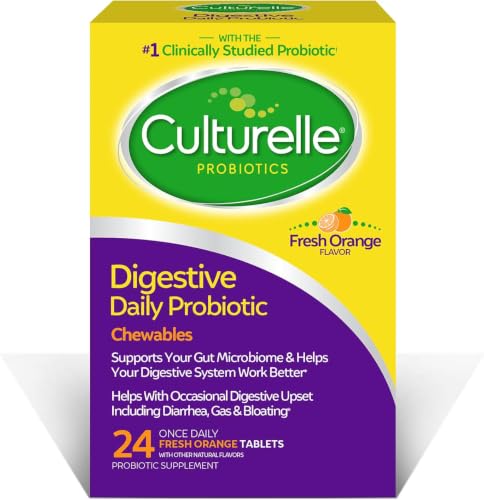
Culturelle is built around one strain — Lactobacillus rhamnosus GG (LGG) — with over 1,000 clinical studies and more than 35 years of research behind it. That's not marketing language; LGG genuinely has more peer-reviewed evidence than almost any other probiotic strain. 10 billion CFUs is a therapeutic dose for daily digestive maintenance, and Culturelle guarantees that count at the expiration date, not just at manufacture. The chewable format is convenient and the formula is allergen-free. The number one pharmacist recommendation in the US is a signal worth paying attention to — pharmacists tend to be skeptical of supplement claims.
Pros:
- LGG strain has 1,000+ published studies — more clinical backing than most competitors
- Potency guaranteed at expiration date, not just manufacture
- Consistently recommended by pharmacists and gastroenterologists
- LGG survives stomach acid better than most strains
- No refrigeration required
- Vegetarian, non-GMO, gluten-free, dairy-free
Cons:
- Single strain — doesn't provide the microbial diversity of multi-strain formulas (though research shows one well-studied strain can outperform ten generic ones)
- Chewable tablets — some people prefer swallowable capsules
- 10 billion CFUs is lower than high-potency options, though the strain quality compensates
- No strains studied for women's vaginal health
Culturelle Digestive Health Daily Probiotic for Women & Men Chewables 24 Ct
Check price on Amazon →
2. Physician's Choice Probiotics 60 Billion CFU — Best High-Potency

Physician's Choice leads the high-potency category. 60 billion CFUs across 10 strains covers a broad range of the GI tract, and the acid-resistant delayed-release capsules increase bacterial viability by 50–70% compared to standard capsules. Organic prebiotic fibers (inulin, acacia, chicory root) give the bacteria something to feed on once they arrive. NSF, GMP, and USP verified. The main caveat: potency is measured at manufacture, not expiration, so the CFU count decreases over the product's shelf life. That's a legitimate limitation for a product emphasizing high potency.
Pros:
- 60 billion CFUs across 10 diverse strains
- Acid-resistant delayed-release capsules
- Organic prebiotic blend (inulin, acacia, chicory root) included
- NSF, GMP, and USP verified
Cons:
- Potency guaranteed at manufacture, not expiration — actual count decreases over time
- 60 billion may cause temporary gas or bloating as your gut adjusts — start with half a dose if sensitive
- Larger capsule size
- Clinical research on the specific 10-strain combination is less deep than single well-studied strains
Physician's CHOICE Probiotics 60 Billion CFU - 10 Strains + Organic Prebiotics - Immune, Digestive & Gut Health - Supports Occasional Constipation, Diarrhea, Gas & Bloating - for Women & Men - 30ct
Check price on Amazon →
3. NOW Foods Probiotic-10 25 Billion — Best Value

NOW Foods has been making supplements since 1968, and they don't dress things up. Probiotic-10 delivers 25 billion CFUs across 10 strains, with DNA verification confirming all strains are present and viable — a quality control step that exceeds standard industry practice. The 25 billion CFU count sits in the middle of the therapeutic range where most research is clustered. No artificial ingredients, gluten-free, dairy-free, vegan. The price per serving is low for a DNA-verified, 10-strain formula from a company with a 50-year track record.
Pros:
- 25 billion CFUs — therapeutic range without excessive doses
- DNA-verified strains confirm what's on the label is actually in the capsule
- NOW Foods' 50-year track record in supplements
- 10-strain formula covers multiple gut regions
- Clean formula, allergen-free
Cons:
- Stock has been limited at some retailers — check availability
- No delayed-release coating specified, which may reduce viability through stomach acid
- No prebiotics included
- Standard bottle packaging without moisture-control technology
NOW Foods Probiotic-10 25 Billion,100 Veg Capsules
Check price on Amazon →
4. Ritual Synbiotic+ — Best Premium

Ritual Synbiotic+ is the most complete gut health formula on this list. It's the only product here combining all three: a prebiotic (PreforPro, which feeds beneficial bacteria while selectively starving pathogens), two of the most studied probiotic strains (LGG and Bifidobacterium animalis BB-12), and a postbiotic (tributyrin, a short-chain fatty acid that directly nourishes intestinal cells). Belgian ProDigest delayed-release capsules show 40–50% higher bacterial viability than standard capsules. Ritual's "Made Traceable" program publishes every ingredient's origin and third-party test results openly.
The 11 billion CFU count is lower than most competitors, which surprises people at the price point. But the strain quality, delivery system, and prebiotic/postbiotic inclusion justify it — this product is engineered for absorption and efficacy rather than impressive numbers on the label.
Pros:
- Combines prebiotics, probiotics, and postbiotics in one capsule
- PreforPro prebiotic selectively feeds beneficial bacteria
- LGG and BB-12 are among the most clinically researched strains available
- Tributyrin postbiotic nourishes intestinal cells directly
- Made Traceable: every ingredient origin published with third-party test results
- Belgian ProDigest capsules with 40–50% higher bacterial viability
Cons:
- Higher price than all other options on this list
- Only 11 billion CFUs — lower than high-potency competitors
- Only 2 probiotic strains
- Fewer buyer reviews than top-selling competitors
Ritual Synbiotic+ 3-in-1 Probiotic Supplement - 30 Capsules - 30 Servings
Check price on Amazon →
5. Garden of Life Once Daily Dr. Formulated Probiotics for Women — Best for Women

Garden of Life's women's formula adds something that general probiotics don't have: Lactobacillus reuteri and Lactobacillus fermentum, two strains specifically studied for vaginal pH balance and UTI prevention. Clinical research shows these strains can reduce UTI recurrence by 30–40%. The formula was developed by Dr. David Perlmutter, a neurologist and integrative medicine author. 50 billion CFUs across 16 strains with organic acacia prebiotic. Cold-processing technology preserves bacterial viability during manufacturing. Shelf-stable, no refrigeration needed.
The main limitation is that the 16-strain count means individual strain doses are necessarily small — some research suggests fewer, well-researched strains at adequate doses outperform many strains at low doses. That said, the two strains specific to women's health (reuteri and fermentum) are the real differentiators here.
Pros:
- L. reuteri and L. fermentum — clinically studied for vaginal pH balance and UTI reduction
- 50 billion CFUs with organic prebiotic
- Formulated by Dr. David Perlmutter
- 16 diverse strains, shelf-stable
- Cold-processing preserves strain viability
Cons:
- At 16 strains in one capsule, individual strain doses are small
- Higher price point
- Larger capsule size
- Gender-specific — doesn't work for shared household use
Garden of Life Once Daily Dr. Formulated Probiotics for Women 50 Billion CFU 16 Probiotic Strains with Organic Prebiotics for Digestive, Vaginal & Immune Health, Dairy Free, Shelf Stable 30 Capsules
Check price on Amazon →
Detailed Comparison Table
| Feature | Culturelle (Best Overall) | Physician's Choice (High-Potency) | NOW Probiotic-10 (Best Value) | Ritual Synbiotic+ (Premium) | Garden of Life (Women's) |
|---|---|---|---|---|---|
| CFU Count | 10 Billion | 60 Billion | 25 Billion | 11 Billion | 50 Billion |
| Number of Strains | 1 (LGG) | 10 diverse | 10 diverse | 2 + Pre/Post | 16 diverse |
| Includes Prebiotic | No | Yes (organic blend) | No | Yes (patented PreforPro) | Yes (organic acacia) |
| Includes Postbiotic | No | No | No | Yes (tributyrin) | No |
| Delivery System | Standard chewable | Delayed-release | Standard capsule | Advanced delayed-release | Raw probiotics tech |
| Clinical Research | 1,000+ studies | General multi-strain | DNA-verified strains | World's most studied | Women-specific strains |
| Best For | Daily digestive support | High-potency needs | Value-conscious buyers | Gut optimization | Women's health |
| Refrigeration | Not required | Not required | Not required | Not required | Not required |
| Third-Party Testing | Yes | NSF/GMP/USP | Yes (DNA verified) | Extensive | Non-GMO certified |
Quick Reference Guide
| Your Priority | Recommended Pick | Why |
|---|---|---|
| Best overall | Culturelle Digestive Health | Most clinically studied single strain, expiration potency guarantee |
| High-potency | Physician's Choice 60B | 60 billion CFUs with 10 strains and acid-resistant capsules |
| Value | NOW Probiotic-10 | DNA-verified 10-strain formula from a 50-year company |
| Women's health | Garden of Life Women's | Strains studied for vaginal pH balance and UTI prevention |
| Premium formula | Ritual Synbiotic+ | Only 3-in-1 with prebiotic, probiotic, and postbiotic |
| Most clinical evidence | Culturelle Digestive Health | LGG has 1,000+ published studies |
| Travel/convenience | Culturelle or Physician's Choice | Both shelf-stable, no refrigeration |
Care Tips & Usage
-
Take at the same time daily — Probiotics work best with consistent daily use over at least 4–12 weeks. Pairing with an existing habit (breakfast, morning coffee) helps with consistency.
-
Continue during and after antibiotics — Take probiotics at least 2–3 hours away from antibiotic doses. Continue for 10 days after finishing the antibiotic course to help restore the microbiome.
-
Store away from heat and humidity — Even shelf-stable probiotics last longer in a cool, dry location. The bathroom cabinet near a hot shower is not ideal.
-
Start lower if you're new to probiotics — Beginning with 10–25 billion CFU formulas for 1–2 weeks before increasing to higher potencies gives your gut time to adjust without temporary gas or bloating.
-
Eat fiber-rich foods alongside — Oats, bananas, garlic, onions, and asparagus feed the beneficial bacteria and enhance probiotic effectiveness.
-
Give it 30 days — Digestive improvements often show within 1–2 weeks, but microbiome changes take 4+ weeks to stabilize.
Common Mistakes When Buying Probiotics
-
Chasing CFU numbers — 60 billion sounds more impressive than 10 billion, but strain quality and survivability matter more. Culturelle's 10 billion LGG outperforms many 50 billion generic blends in clinical research.
-
Ignoring strain specificity — "Probiotic blend" on a label tells you almost nothing. Look for full strain names. Research is strain-specific — Lactobacillus rhamnosus GG has completely different properties from other Lactobacillus rhamnosus strains.
-
No delivery protection — Standard capsules can lose 70–90% of bacteria to stomach acid. Delayed-release capsules are worth paying for.
-
Manufacture date vs. expiration date — Some brands guarantee CFU count at manufacture, meaning potency drops as the product sits on shelves. Look for expiration date guarantees.
-
Quitting too early — Microbiome changes are gradual. Give any probiotic at least 30 days before concluding it doesn't work.
FAQ
Q: How many CFUs do I actually need?
A: Research clusters around 10–50 billion CFUs for most digestive health goals. Ultra-high doses (60+ billion) haven't consistently shown additional benefits and can cause temporary gas as your gut adjusts. Start at 10–25 billion if you're new to probiotics.
Q: Should I take probiotics with food or on an empty stomach?
A: Most probiotics work fine with or without food. Research suggests that taking them with a meal containing some fat may improve bacterial survival through stomach acid. Consistency of timing matters more than the specific timing.
Q: How long before I see results?
A: Most people notice some change in digestion and bloating within 1–2 weeks. Full microbiome benefits typically emerge after 4–12 weeks of daily use. If nothing changes after 6–8 weeks, the specific strains may not be the right match for your issue.
Q: Can I take probiotics while on antibiotics?
A: Yes, and it's generally recommended. Take probiotics at least 2–3 hours away from antibiotic doses to avoid direct interaction. Continue for 10 days after finishing antibiotics to help restore the beneficial bacteria the course disrupted.
Q: Do probiotics need refrigeration?
A: Modern shelf-stable formulations don't require refrigeration, but still benefit from storage away from heat and moisture. Check your specific product's label.
Q: Are multi-strain probiotics better than single-strain?
A: Not necessarily. Culturelle's single LGG strain has more clinical backing than many 10-strain blends. Choose based on your goal: single well-studied strains for targeted benefits; multi-strain for broader microbiome support. Strain quality outweighs quantity every time.
Final Verdict
Culturelle is the clearest starting point for most people. One strain with 1,000+ clinical studies, a pharmacist recommendation track record, and an expiration-date potency guarantee is a more compelling case than most high-CFU multi-strain formulas can make. If you have ordinary digestive complaints or want daily maintenance, start here.
Physician's Choice 60B is the better choice if you're dealing with significant digestive issues — bloating, gas, irregularity — and want high-dose, multi-strain support with acid-resistant delivery. Just know the potency guarantee is at manufacture, not expiration.
Garden of Life Women's is the obvious pick for women who want both digestive support and the clinically studied strains specific to vaginal health. The UTI prevention research on L. reuteri and L. fermentum is real and meaningful.
Ritual Synbiotic+ is worth the premium if you want the most scientifically complete formula and value transparency. The prebiotic-probiotic-postbiotic combination is well-designed, and the "Made Traceable" sourcing disclosure is the most honest thing any supplement brand currently offers.
Whichever you choose, take it daily for at least 30 days, store it properly, and pair it with a diet that includes fiber-rich foods. Consistency matters more than which product you pick.
Related: Check out our guides on best foam rollers for recovery and best infrared sauna blankets for recovery.
Recommended
Best Bug Bite Relief Devices of 2026: Heat Pens That Stop the Itch Without Creams
Best bug bite relief devices 2026: heat pens that stop mosquito itch in seconds, no creams or chemicals needed. Beurer, Vibis, and budget picks compared.

Best Pantry Organizer Bins of 2026: Amazon Sets That Actually Fix Cabinet Clutter
Best pantry organizer bins 2026: airtight containers and stackable bins that end cabinet clutter for good. Tested for seal strength, shelf fit, stackability.

5 Best Hand & Wrist Massagers of 2026: Electric Compression Devices That Actually Help Typing, Scrolling & Mom-Life Pain
Best hand and wrist massagers 2026: Lunix LX7 vs COMFIER, Breo and Musugy compression massagers, tested for carpal tunnel and typing pain relief.
