Top 3 Wireless Lavalier Microphone Systems for Content Creators 2026
Best wireless lavalier mic systems for content creators in 2026. DJI Mic 2, Rode Wireless GO II & more — compared for range, audio quality & ease of use.

Top 3 Wireless Lavalier Microphone Systems for Content Creators 2026
Bad audio ends a video faster than bad video does. A wireless lavalier system clips near your mouth, transmits wirelessly to your camera or phone, and lets you move around without being tethered by a cable. The three systems below cover different priorities: ecosystem integration for mobile creators, maximum reliability for professional shoots, and minimal visibility for lifestyle vlogging.
Quick Answer
DJI Mic 3 is the best overall wireless lavalier system for content creators — 32-bit float recording, 820 ft range, direct phone connectivity without a receiver dongle, and a charging case that doubles as a receiver for on-the-go recording. Rode Wireless PRO is the better choice for professional video shoots where you need longer battery life (40 hours), internal backup recording directly to the transmitter, and the most reliable RF signal in crowded environments.
Table of Contents
- Quick Comparison Table
- How We Test Wireless Lavalier Systems
- What to Look For in Lavalier Microphones
- Product Reviews
- Detailed Comparison Table
- Quick Reference Guide
- Battery and Maintenance Tips
- Common Mistakes When Buying Lavalier Systems
- FAQ
- Final Verdict
Quick Comparison Table
| Name | Battery Life | Range | Recording Quality | Best For |
|---|---|---|---|---|
| DJI Mic 3 | 28 hours | 820 ft | 32-bit float + 24-bit | Mobile streaming |
| Rode Wireless PRO | 40 hours | 656 ft | 32-bit float | Professional filming |
| Hollyland Lark M2 | 40 hours | 984 ft | 48kHz/24-bit | Discreet vlogging |
How We Test Wireless Lavalier Systems
Each system was tested in real recording conditions:
- Audio quality - clarity, noise handling, and distortion across different environments
- Signal reliability - wireless stability, interference resistance, and dropout prevention in mixed-signal environments
- Battery life - actual runtime under typical usage conditions versus stated specs
- Compatibility - connections tested with cameras, smartphones, and audio interfaces
- Portability - size, weight, and charging case convenience for travel
- Feature performance - noise cancellation accuracy, gain control behavior, recording mode options
Testing scenarios included indoor recording, outdoor with wind and traffic, crowded events, and streaming from a phone.
What to Look For in Lavalier Microphones
- Recording quality - 24-bit or higher with a low noise floor; 32-bit float is worth having for insurance against loud unexpected sounds
- Battery life - 20+ hours total for extended shoots without mid-day charging breaks
- Wireless range - 300-500 feet minimum for reliable performance in open spaces
- Noise cancellation - active noise reduction that isolates vocals rather than just reducing overall level
- Connectivity - 3.5mm, USB-C, and Lightning options for different devices
- Form factor - transmitters small enough not to visibly distort clothing
32-bit float recording is worth prioritizing if you record in unpredictable environments. It captures such a wide dynamic range that you can recover audio that clipped or was recorded too quietly — a safety net that standard 24-bit doesn't provide.
Detailed Product Reviews
- DJI Mic 3 - Best Integrated Ecosystem

The DJI Mic 3 is the most practical wireless lavalier for mobile creators — particularly those already using DJI cameras, Pocket 3, or Action 5. Direct Bluetooth connectivity to compatible DJI devices and smartphones removes the need to carry a separate receiver. Dual-mode recording captures both 32-bit float (for safety backup) and 24-bit lossless simultaneously. The adaptive gain control keeps vocal levels consistent without constant manual adjustment. At 30g per transmitter, it packs easily.
Pros:
- Dual-mode recording: 32-bit float and 24-bit lossless simultaneously
- 28-hour total battery with redesigned charging case
- Smart dual-band anti-interference transmission
- Direct Bluetooth to smartphones and DJI cameras without receiver
- Adaptive gain control for consistent vocal levels
- Lightweight and compact design
Cons:
- More expensive than basic wireless systems
- Without receiver, compatibility with non-DJI devices is limited
- Noise cancellation is functional but less sophisticated than dedicated streaming mics
DJI Mic 3 (2 TX + 1 RX + Charging Case), Wireless Microphone
Check price on Amazon →
👉 View product details
(#ad)
- Rode Wireless PRO - Best Professional Reliability
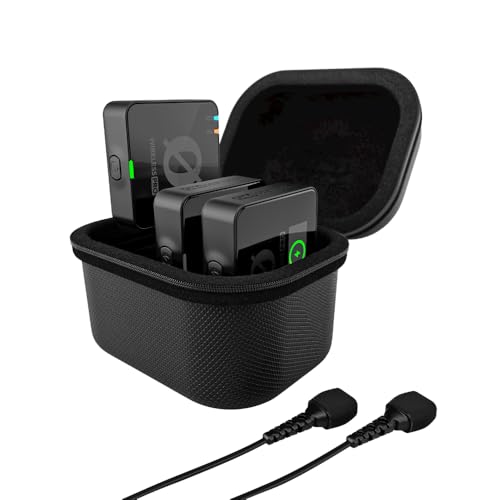
The Rode Wireless PRO is the choice when you can't afford to miss audio. Each transmitter records 32-bit float on-board — if the wireless signal drops for any reason, the backup audio on the transmitter itself is intact and at the same quality as the live signal. Timecode capability syncs audio perfectly with camera footage in post-production. The Series IV 2.4GHz transmission with 128-bit encryption is reliable in RF-congested environments like events and crowded locations. The locking 3.5mm connector prevents accidental disconnection mid-shoot.
Pros:
- On-board 32-bit float recording on each transmitter as backup — failsafe against signal loss
- Intelligent GainAssist prevents clipping and quiet audio automatically
- Series IV 2.4GHz digital transmission with 128-bit encryption
- Timecode for perfect audio-video sync in post-production
- Locking 3.5mm connectors prevent accidental disconnection
- Comprehensive cable kit (USB-C, Lightning, TRS, TRRS) and charging case included
Cons:
- The feature depth has a learning curve — not a pick-it-up-and-go system
- Bulkier than minimalist systems
- More than casual vloggers need or want to spend
RØDE Wireless PRO Compact Wireless Microphone System with Timecode, 32-bit Float On-board Recording, 2 Lavalier Microphones and Smart Charge Case for Filmmaking and Content Creation
Check price on Amazon →
👉 View product details
(#ad)
- Hollyland Lark M2 - Best Discreet Design

The Lark M2 is 9g per transmitter — about the size and weight of a large button. It clips to clothing without creating a visible bulge, which matters for lifestyle vlogging where a clip-on microphone shouldn't be the focus of the shot. Audio quality is solid: 48kHz/24-bit with a 70dB signal-to-noise ratio. One-click noise cancellation reduces wind, traffic, and ambient noise effectively. The 300m transmission range is the widest of the three, and plug-and-play versions with Lightning or USB-C connector remove the need for a receiver with phones.
Pros:
- 9g transmitter is the smallest and least visible of these three
- 40-hour total battery life with charging case
- 48kHz/24-bit audio with 70dB SNR
- One-click noise cancellation for wind and traffic noise
- 300m (984 ft) transmission range
- Plug-and-play phone versions available (Lightning or USB-C)
- UAC support for direct computer connection
Cons:
- Price is high for a system without on-board backup recording
- More limited advanced features compared to Rode
- Mic placement needs to be precise for optimal capture at this size
Hollyland Lark M2 Wireless Microphone for iPhone/Camera/Android/PC, 48kHz/24-bit High Fidelity Audio, 300m Range, Noise Cancelling, 40h Use, YouTube, Vlog, Streaming (2TX + 3RX + Charging Case)
Check price on Amazon →
👉 View product details
(#ad)Detailed Comparison Table
| Feature | DJI Mic 3 | Rode Wireless PRO | Hollyland Lark M2 |
|---|---|---|---|
| Recording Quality | 32-bit float + 24-bit | 32-bit float | 48kHz/24-bit |
| Battery Life | 28 hours | 40 hours | 40 hours |
| Range | 820 ft | 656 ft | 984 ft |
| Noise Cancellation | 2-level ANC | Intelligent GainAssist | One-click ENC |
| Weight (TX) | 30g | 31g | 9g |
| Connectivity | Bluetooth + 3.5mm | USB-C/Lightning/TRS | 3.5mm + UAC |
| Backup Recording | Yes (TX) | Yes (TX) | No |
| Best For | Mobile creators | Professional filming | Discreet vlogging |
Quick Reference Guide
| Use Case | Recommended Pick | Why |
|---|---|---|
| Mobile streaming | DJI Mic 3 | Direct phone and DJI camera connectivity |
| Professional filming | Rode Wireless PRO | 32-bit float backup and timecode for post-production safety |
| Lifestyle vlogging | Hollyland Lark M2 | 9g transmitter that doesn't show in clothing |
| Podcasting | Rode Wireless PRO | Reliable signal and gain control for consistent studio-quality audio |
| Quick social media | DJI Mic 3 | Bluetooth phone connection for fast setup |
Battery and Maintenance Tips
- Charge regularly - Keep transmitters in the case even between shoots
- Avoid extreme temperatures - Operate within 32-104°F for optimal battery performance
- Clean contacts - Wipe charging contacts monthly with a soft cloth
- Update firmware - Check manufacturer apps for performance improvements
- Store in case - Prevents dust accumulation on connectors
- Test before important shoots - Do a 30-second sound check to verify signal strength and audio quality
Common Mistakes When Buying Lavalier Systems
- Ignoring range requirements - Indoor use is forgiving; outdoor and event use needs longer range
- Underestimating battery - All-day shoots need 20+ hours total capacity
- Skipping noise cancellation - Traffic, wind, and AC units all affect outdoor and travel recording
- Wrong connectivity - Verify your primary recording device's input before buying
- No backup recording - 32-bit float on-board backup on the Rode or DJI is worth paying for on important shoots
FAQ
Q: What's the difference between wireless lavalier and shotgun microphones?
A: Lavalier mics clip near your mouth for close, consistent vocal pickup — good for interviews, presentations, and single-speaker content. Shotgun mics are directional and capture sound from a distance, making them better for filming multiple people or capturing ambient audio. Lavaliers suit mobile content creation; shotguns suit film and documentary work.
Q: Can wireless lavalier systems be used for streaming?
A: Yes. These systems connect to phones, computers, and cameras, and work well for live streaming platforms. The noise cancellation features specifically help in home environments with keyboard, fan, and ambient noise.
Q: What's 32-bit float recording and why does it matter?
A: 32-bit float captures an extremely wide dynamic range — loud sounds don't clip, and quiet sounds can be boosted in post without audible noise. You can fix audio level mistakes in editing that 24-bit recording would make permanent. For unpredictable recording situations, it's a meaningful safety net.
Q: How do I choose between these three systems?
A: DJI Mic 3 if you shoot on a phone or DJI camera and want plug-and-play simplicity. Rode Wireless PRO if missing audio on a shoot is not acceptable and you edit in post. Hollyland Lark M2 if the transmitter being invisible in the shot matters more than backup recording.
Q: Are wireless lavalier systems secure for sensitive recordings?
A: The Rode uses 128-bit encrypted transmission. For most content creation, standard transmission is fine. For legally sensitive recordings, consider wired alternatives and consult local privacy laws.
Q: Is the Hollyland Lark M2 worth it without on-board backup recording?
A: If you're doing lifestyle vlogging where the transmitter disappearing in the shot matters most, yes. But it lacks the 32-bit float safety net that the DJI Mic 3 and Rode both include, so a dropped wireless signal means the audio is gone with no way to recover it in post. Weigh that trade-off carefully for anything you can't reshoot.
Q: What's the main trade-off between the DJI Mic 3 and the Rode Wireless PRO?
A: The DJI Mic 3 connects directly to phones and DJI cameras over Bluetooth with no receiver needed, but it's more limited with non-DJI gear and its noise cancellation is less refined. The Rode Wireless PRO is receiver-based, bulkier, and has a real learning curve, but its timecode sync and GainAssist make it the more dependable choice for professional post-production work.
Q: How long does the battery last on a full day of shooting?
A: The Rode Wireless PRO and Hollyland Lark M2 both offer roughly 40 hours of total battery life including the charging case, enough for multi-day shoots without recharging. The DJI Mic 3 offers 28 hours, still enough for a full day of shooting with the case topping off the transmitters between uses.
Final Verdict
The DJI Mic 3 is the best starting point for most content creators — particularly mobile shooters. The dual-mode recording gives you 32-bit float backup plus 24-bit lossless, the Bluetooth direct connection removes setup friction, and the charging case handles 28 hours of total use.
For professional productions where missed audio is unacceptable, the Rode Wireless PRO is worth the investment. On-board backup recording on each transmitter, timecode sync, and interference-resistant transmission address the failure modes that matter on professional shoots.
The Hollyland Lark M2 is the right pick for lifestyle vloggers and interview-style content where the microphone shouldn't visually register. Nine grams and a button-sized form factor solve a problem the other two systems don't address.
Related: Check out our guides on best webcams for streaming and Zoom, best wireless earbuds, and best portable chargers.
Recommended
The 2026 Audio Upgrade: Which Amazon Smart Speaker Is Actually Right for Your Room?
Best Amazon Echo speakers 2026: Sound quality & smart home control compared. Find the perfect fit for your room. See our comparison.

The Best E-Readers for Every Reader: Kindle Paperwhite, Colorsoft & Scribe 2026 Guide
Best e-readers 2026: Kindle Paperwhite, Colorsoft, Scribe & Kobo compared. Find the perfect device for your reading habits. See our guide.

5 Best Smart Rings for Health Tracking 2026: Oura Ring 4 and Premium Alternatives
RingConn Gen 2 wins on battery (10-12 days) with no monthly subscription. Oura Ring 4 has the deepest data but you pay ongoing fees. Our 2026 comparison.
